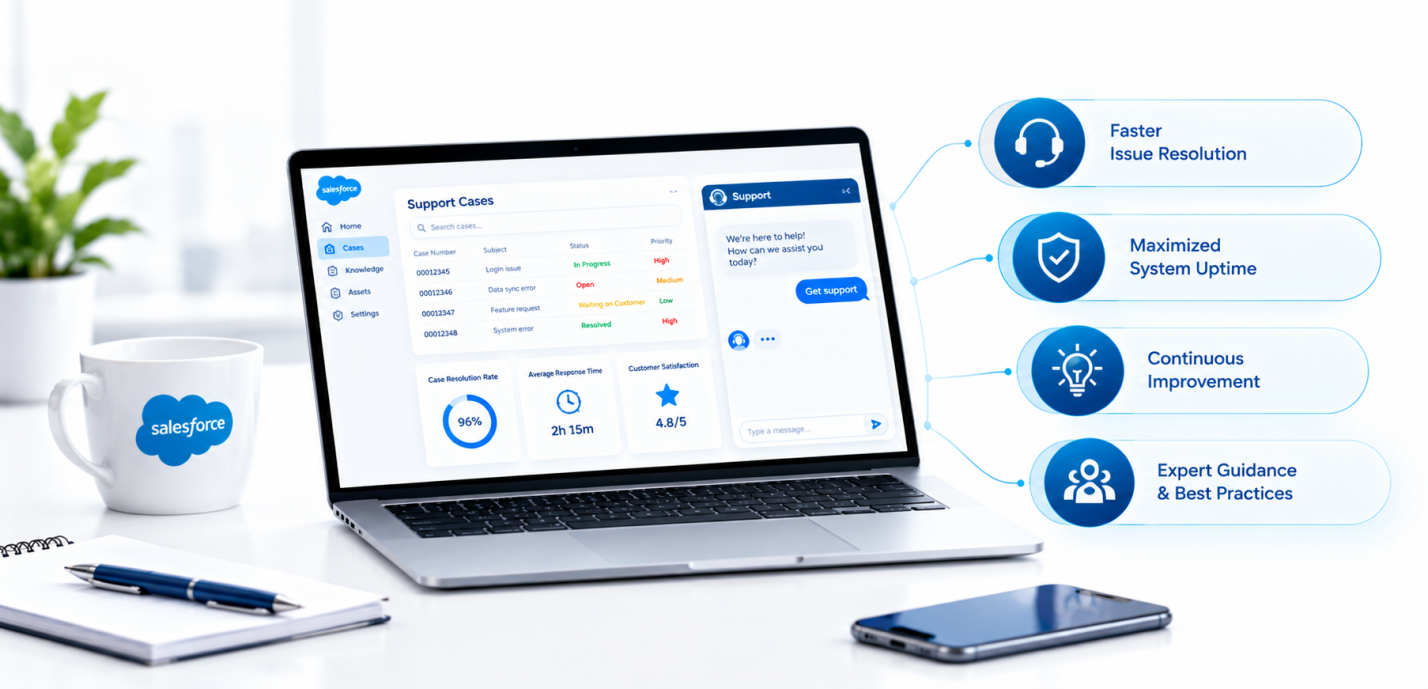
Most Salesforce projects get all their attention at the start. The planning, the setup, the big go-live day. Then the team moves on, and the real story begins. Because a CRM is a living thing. It drifts, it breaks, and it slowly stops matching how people actually work. That slow decay is the gap good Salesforce support services are built to fill.
And the drift is quiet. A field nobody uses. A report that stopped updating. An automation that fires at the wrong time. None of it looks urgent on its own. Add it up over a year, and the system people loved at launch feels like a chore.
What Salesforce support services actually cover
The name sounds like a help desk. It is more than that. The job is to keep the platform working, growing, and matching the business as the business changes.
Good Salesforce support services do three jobs at once. They fix what breaks, fast. They tune the setup as teams shift how they work. And they add new pieces as the company grows, without turning the whole thing into a mess.
The day-to-day work
- Fixing broken automations and reports before they slow people down.
- Cleaning up data, so dashboards stay accurate and trusted.
- Adjusting fields and flows as teams change how they sell or serve.
- Adding features and integrations as new needs show up.
Why most teams cannot do this alone
The usual plan is to hand Salesforce to one admin and hope for the best. That works until it does not. One person cannot know every corner of the platform, and Salesforce changes three times a year.
So the admin spends their days firefighting. Small requests pile up. Big improvements never happen. The person meant to make the CRM better is too busy keeping it alive. A support partner takes that weight off, so the in-house team can think ahead instead of just reacting.
Where AI agent development services change the game
Here is where support gets interesting. A big share of support work is the same questions, over and over. How do I reset this. Where is that report. Why did this field not save. People, doing by hand, what a machine could answer in a second.
This is the job of AI agent development services. They build small, focused agents that sit inside Salesforce and handle the routine asks on their own. A user types a question, the agent answers, and a human never has to touch it. The hard tickets still reach a person, but the easy ninety percent do not.
The effect is simple. Your support team stops drowning in repeat questions and gets time for the work that needs a human. These agents do not replace the support team. They clear the noise so the team can do the part that matters.
How support and agents work together
Picture a company a year after launch. An agent handles the common questions the moment they come up. The support partner watches the platform, fixes the real problems, and adds new features on a steady schedule.
Now picture the opposite. One tired admin. A backlog of tickets. An agent nobody built, so every question goes to a human. Same CRM, very different year. The difference is whether anyone planned for life after launch.
Signs your CRM is quietly falling behind
The decline rarely announces itself. It shows up in small frustrations that people stop reporting because nothing changes.
- Reps keep data in spreadsheets because the CRM feels like extra work.
- Reports take ages to load, or nobody trusts the numbers anymore.
- The same support questions come up every single week.
- New hires get a shrug when they ask how a process is supposed to work.
Any one of these is a signal the platform has outgrown its setup. The fix is ongoing care, not another big rebuild a year from now.
How to choose the right support partner
The partner you pick decides whether your CRM gets better each month or just stays alive. A few signals help you tell them apart.
- They plan improvements, not just answer tickets.
- They know the platform deeply, through every seasonal release.
- They can build automation and AI agents, not only fix bugs.
- They talk about your outcomes, like faster service or cleaner data.
A partner who asks where you want the CRM in a year is the one worth hiring. The rest will happily stay in firefighting mode forever.
Frequently asked questions
What are Salesforce support services?
They are the ongoing work of keeping a Salesforce setup healthy after launch. That covers fixing problems, tuning the system as teams change, cleaning data, and adding new features over time.
How are support services different from the first setup?
The setup gets you live. Support keeps you useful. A CRM drifts as the business changes, so steady care is what stops it from quietly going stale.
What are AI agent development services?
They build small, focused agents that handle routine tasks on their own. Inside Salesforce, a well-built agent can answer common questions so a human only sees the hard ones.
Will AI agents replace our support team?
No. They clear the repetitive questions so the team has time for the work that needs judgment. The people handle the tricky cases, the agent handles the rest.
How do we start without a big commitment?
Begin with a support plan for the issues you already have. Add one AI agent for your most common question. Prove the time it saves, then expand.
The bottom line
Go-live is the easy part. Keeping a CRM useful for years is the real test. Strong Salesforce support services handle that slow, steady work, fixing the breaks and matching the system to how people actually work. Add AI agents on top, and the routine questions answer themselves. The result is a platform that keeps earning its keep, long after the launch party.




Leave a Reply