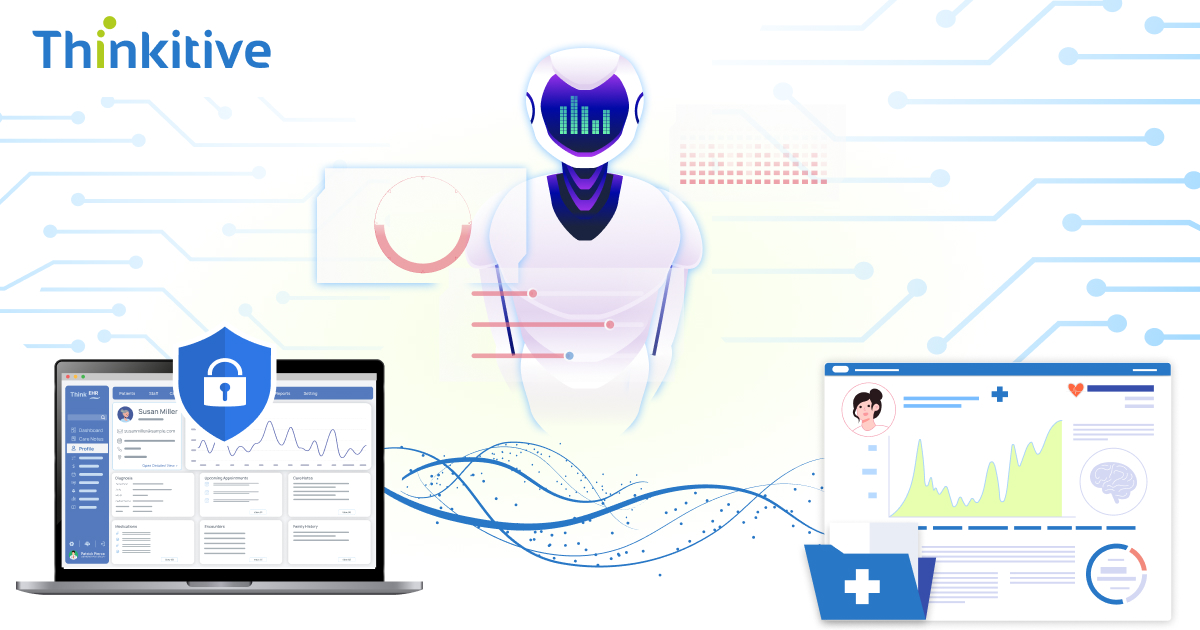
Over the next decade or two, most, if not all, patient interactions will occur through digital channels and will transform how care is delivered, managed, and experienced. However, this change is not gradual but happening at a breakneck speed due to the continuously advancing technology, evolving regulations, and the need for seamless and connected patient care.
However, in the midst of this rapid digital advancement in healthcare, many healthcare organizations are facing a significant challenge: balancing the need to deliver seamless care while preparing for future changes in the healthcare industry. Therefore, organizations need to embrace digital transformation as soon as possible to leverage the advantages of connected and integrated care.
This is where EHI integration comes in.
A well-integrated EHR is not just a tool to bring interoperability and deliver seamless patient care; it’s a digital nervous system of modern healthcare organizations. And most importantly, EHR integration provides the foundation necessary for healthcare interoperability, enabling your organization to stay current with regulatory changes and capitalize on emerging technologies.
The future of healthcare is integrated, intelligent, and data-driven, and in this article, we will explore how EHR integration can help you not only survive but thrive in the next era of healthcare.
Adapting to Evolving Care Delivery Models
Care delivery is transforming day by day, and EHR integration gives you the base and means to adapt to these rapid changes. For instance, value-based care delivery requires comprehensive quality measurement tracking, which necessitates the complete collection of patient data. And this data can only be provided by fully integrated systems.
Moreover, with patient data analytics capabilities in healthcare interoperability solutions, processes like risk stratification and care gap identification become precise and accurate. And when it comes to utilizing precision medicine in your practice, there is a need for seamless integration of genomic data with traditional clinical records.
Advanced EHR integration platforms give you the ability to incorporate genetic data into clinical data. Enabling personalized treatment protocols and enhanced clinical decision support through the patient phenotyping functionalities.
Nowadays, most patient encounters that are not critical happen digitally with telemedicine, and this calls for hybrid care models. Integrated EHR platforms combine traditional care and telehealth seamlessly, allowing for continuous care delivery with remote monitoring.
Empowering patients is another critical shift requiring robust integration capabilities. Patients expect to have free and complete access to health information through patient portals, seamless integration with third-party apps for data portability. Also, shared decision-making tools for having a choice in their health decisions.
And all of this is provided with EHR integration or added as needed, giving healthcare organizations the power to adapt quickly to new developments.
Emerging Technology Integration & Innovation Enablement
Emerging technologies are transforming healthcare by making it smarter, safer, and more personalized. Innovations like AI, IoT, blockchain, and AR/VR are becoming essential tools that connect care, improve outcomes, and enhance patient experiences.
AI and machine learning are helping doctors make faster, more accurate decisions by analyzing large volumes of data and offering personalized recommendations. This shift from rigid, rule-based systems to intelligent, data-driven insights is improving diagnostics and treatment planning.
At the same time, wearable devices and connected sensors are enabling real-time monitoring of patients, both inside and outside the hospital. This continuous flow of data supports better telehealth services, proactive care, and smarter hospital operations.
Blockchain brings added trust to healthcare by ensuring data integrity and enabling secure sharing of information across systems, critical for patient privacy and collaborative research.
Meanwhile, AR and VR are revolutionizing how healthcare professionals learn and practice, while also improving patient education and therapy delivery through immersive experiences.
Together, these technologies are building a more connected and efficient healthcare ecosystem. When integrated properly, they allow providers to deliver care that’s not only faster and safer but also truly centered around the individual patient. The future of healthcare isn’t coming, it’s already here, and it’s digital.
Regulatory Compliance & Standards Evolution Management
In healthcare, regulations evolve continuously, and keeping up with the changes and remaining compliant is not easy. But EHR integration’s architectural foundation, adapting to regulatory changes while maintaining efficient operation and avoiding costly penalties, becomes possible.
The information blocking rules and patient access mandates require healthcare organizations to provide unhindered data access. EHR integration completes this need through API-first architectures that support seamless third-party application integration.
Integrated systems also make sure that audit trails are generated properly and documented, ensuring transparency. Automated patient data sharing also ensures that there is no blockage in information sharing.
The FHIR-based architecture of EHR integration ensures that your system supports all healthcare interoperability solutions. It also gives your organization the ability to seamlessly exchange data in multi-standard environments, improving care coordination.
Moreover, with time, privacy and safety regulations are becoming more strict, particularly with healthcare becoming digital and globally connected. With a dynamic governance framework, the systems can be easily updated to comply with revised rules and regulations. Along with security approaches like data encryption, patient data remains secure.
Scalability & Organizational Growth Support
Healthcare organizations need to grow and, with the integrated EHR systems, provide the needed growth support for the organization. Mergers and acquisitions are happening in healthcare with increasing frequency, and they need to integrate their EHR systems.
EHR integration platforms give organizations the ability to seamlessly integrate systems with minimal disruption in workflows. Moreover, organizations with EHR integration can complete the mergers within months, and this becomes a competitive advantage for these organizations.
When it comes to geographic expansion and multi-site operation, you need a centralized data access for delivering efficient and continuous care. EHR integration gives you that, along with standardized care protocols that can be customized to match the local needs and rules.
In addition to this, you also get the flexibility to open or expand service lines with the ability to integrate new capabilities without completely rebuilding existing systems. Modern EHR integration supports specialty-specific workflows through configurable platforms, allowing for medical research and clinical trial integration for academic and specialty care expansions.
Finally, with EHR integration, collaboration with different healthcare facilities becomes possible as data sharing is secured. This facilitates community health partnerships and accountable care organizations partnerships through shared patient data and standardized care protocols.
Economic Sustainability & Financial Future-Proofing
When healthcare organizations implement EHR integration, they open the door to both immediate and long-term financial returns. Integrated EHR systems provide multiple options that help organizations to optimize the total cost of ownership.
Its modular and scalable integration architecture, along with cloud-based platforms, reduces long-term maintenance and upgrade costs. With its ability to integrate with multiple vendors and third-party applications, your dependency on a single vendor is eliminated.
Organizations can also open new revenue streams that were previously unavailable to them. For instance, EHR integration enables research participation and patient data contribution, opens new ways to earn revenue. Quality bonus achievements become more attainable through integrated performance measurement.
As for gaining immediate benefits, with intelligent automation, operational processes become efficient and save time and money. Workflow automation reduces manual labor costs while predictive analytics optimizes resource utilization and eliminates waste.
Data Security & Privacy in an Evolving Threat Landscape
As healthcare is becoming digital, the cybersecurity threats are also intensifying, and this is why modern healthcare organizations need robust security measures. And EHR integration brings to the table ways to fulfill future data security needs.
First, zero-trust architecture has become essential for healthcare organizations supporting distributed care delivery models. Threat detection and response systems integrate with clinical workflows and enable real-time security monitoring.
With time, patient privacy protection becomes more complicated as healthcare systems become connected. Dynamic consent management systems give patients complete control over who views and modifies their information. Privacy-preserving analytics allow population health insights without compromising individual privacy.
Organizations need to monitor the compliance requirements and alert authorities in case of attack, and EHR integration automates this process, reducing the chance of error and administrative burden. And finally, security awareness and training integration ensures staff know the emerging cyberthreats and compliance requirements.
Conclusion
In the future healthcare landscape, the organization needs to adapt, integrate, and evolve with changing needs and requirements. And in a well-planned EHR integration can be a tremendous advantage with its flexible and adaptable infrastructure.
So, organizations need to invest in EHR integration and healthcare interoperability solutions alongside developing custom EHR software to keep pace with the evolving healthcare needs. That’s why the strategic decisions you make about EHR integration today will determine your competitive position for the future.
Frequently Asked Questions
- How can healthcare organizations balance investing in current EHR integration needs while preparing for future technological changes?
Healthcare organizations can balance current EHR integration needs with future technological changes by investing in interoperable and scalable systems. Prioritize cloud-based solutions, APIs, and open standards like FHIR and HL7 to ensure seamless data exchange and adaptability to emerging technologies like AI and predictive analytics.
- What role will artificial intelligence play in the future of EHR integration and healthcare interoperability?
AI will be crucial for seamless EHR integration and healthcare interoperability. It will automate data standardization, enable intelligent data sharing across disparate systems, and power real-time analytics for comprehensive patient insights, leading to improved care coordination and outcomes.
- How should healthcare organizations prepare for evolving regulatory requirements around data sharing and patient access?
Healthcare organizations should prioritize robust data governance, implement interoperable systems, and conduct regular security audits. They must also enhance patient consent mechanisms, continuously train staff on evolving regulations like HIPAA and the 21st Century Cures Act, and invest in secure data exchange technologies to ensure compliance and maintain trust.
- What are the key architectural principles for building future-ready healthcare integration platforms?
Future-ready healthcare integration platforms prioritize interoperability (FHIR), scalability, security and privacy, modularity, and real-time data exchange. They focus on patient-centricity, enabling seamless data flow across systems while ensuring data integrity, compliance, and adaptability to evolving healthcare needs.
- How can smaller healthcare organizations afford to implement future-proof EHR integration solutions?
Smaller healthcare organizations can afford future-proof EHR integration by prioritizing cloud-based, subscription-model solutions with pre-built APIs. Focusing on essential features, leveraging shared data, and investing in cost-effective training for creating superusers can also reduce expenses and ensure long-term value.
- What emerging healthcare technologies will most significantly impact EHR integration requirements?
The emerging technologies that will significantly impact EHR integration requirements are AI and machine learning, wearable, remote patient monitoring, and genomic medicine, which will profoundly impact EHR integration. These technologies demand enhanced interoperability, standardized data formats, robust security, and advanced analytics capabilities to manage vast, diverse datasets for comprehensive patient analysis.
- How will value-based care models change the requirements for healthcare interoperability solutions?
Value-based care demands comprehensive, real-time data exchange across diverse systems such as EHRs, payers, and labs to track outcomes, manage populations, and coordinate care. This shifts interoperability requirements towards semantic understanding, standardized data formats like FHIR, and robust APIs for seamless, secure data flow, ensuring all stakeholders have a holistic patient view.
- What security considerations are most critical for future-proofing healthcare data integration?
For future-proofing healthcare data integration, critical security considerations include robust encryption, strong access controls like role-based access, continuous monitoring for threats, strict regulatory compliance such as HIPAA and GDPR, and a focus on interoperability standards to enable secure data exchange while adapting to evolving cyber threats and technologies.
- How can healthcare organizations ensure their EHR integration investments remain valuable as technology evolves?
Healthcare organizations can ensure EHR integration value by prioritizing interoperability standards such as, FHIR, adopting modular, API-driven architectures, and embracing cloud-based solutions. Continuous monitoring, robust security, and AI-driven data management also future-proof investments as technology evolves.
- What role will patient data ownership and control play in future healthcare interoperability?
Patient data ownership and control will be foundational for future healthcare interoperability. Empowering patients to manage their data fosters trust, enhances data accuracy, and drives more patient-centric care. It will incentivize secure, standardized data exchange, moving healthcare toward truly collaborative and efficient systems.
- How will the evolution of telehealth and remote care impact EHR integration requirements?
The evolution of telehealth necessitates robust EHR integration for seamless data exchange, ensuring providers have real-time patient information during virtual visits. This demands enhanced interoperability, standardized data formats, and robust security to maintain comprehensive, accessible, and secure patient records across all care modalities.
- What partnerships and collaborations should healthcare organizations consider for future-ready integration?
For future-ready integration, healthcare organizations should consider partnerships with technology vendors, other healthcare providers like specialty care, community health, and payers/insurers. These collaborations foster innovation, enhance data interoperability, improve patient access, and streamline care delivery for a more integrated ecosystem.




Leave a Reply