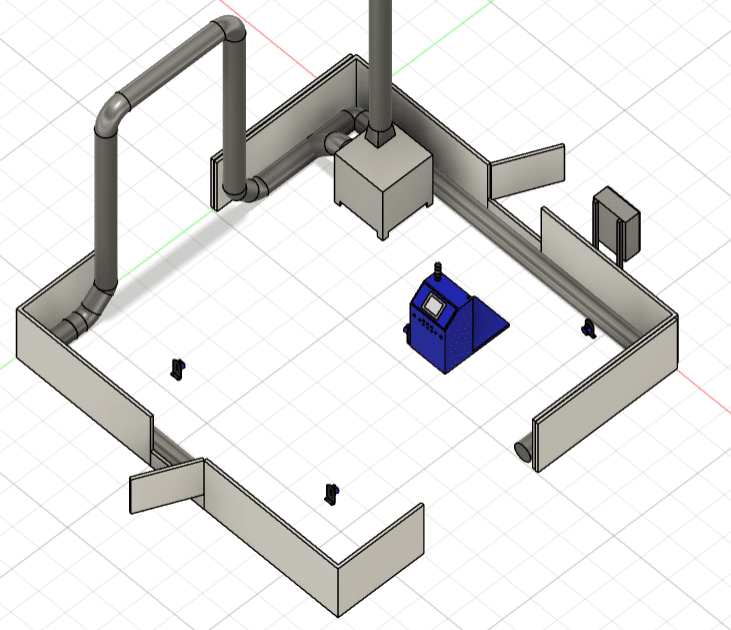
Risk management in manufacturing usually sounds more dramatic than it feels. Most days, it’s not about alarms blaring or people sprinting for exits. It’s about quiet decisions made during design reviews, layout planning, and safety meetings—the kind where someone asks, “What happens if this leaks?” and everyone suddenly pays attention.
That question matters a lot when you’re dealing with flammable refrigerant charging area safety (A2L/A3).
As A2L and A3 refrigerants become more common on production floors, manufacturers are learning that managing risk isn’t about fear. It’s about control. The goal isn’t to eliminate risk entirely (that’s not realistic), but to design systems where risk is predictable, contained, and well understood.
Let’s talk about how manufacturers are doing exactly that—and why the smartest ones treat charging zones as engineered environments, not just another workstation.
Why A2L and A3 Charging Zones Deserve Special Attention
A2L and A3 refrigerants sit in different flammability categories, but from a manufacturing perspective, they share something important: they change how charging areas must be designed, monitored, and operated.
These refrigerants are efficient and environmentally attractive, but they introduce new variables:
- Flammability limits
- Ignition source control
- Ventilation performance
- Emergency response behavior
Ignoring those variables doesn’t make them disappear. It just makes them unpredictable—and unpredictability is what manufacturers work hardest to avoid.
Risk Isn’t Just About the Refrigerant
One of the most common misconceptions is that risk lives entirely inside the refrigerant itself. In reality, risk is shaped by everything around it.
The Environment Shapes the Outcome
A small refrigerant release in a well-designed, ventilated charging zone is a controlled event. The same release in a poorly planned area can escalate quickly.
Factors that influence risk include:
- Airflow patterns
- Equipment spacing
- Electrical classifications
- Human traffic through the area
This is why charging zones can’t be an afterthought. They need to be designed as systems, not spaces.
Zoning: The First Line of Defense
Zoning is one of the most effective tools manufacturers have for managing A2L and A3 charging risks.
Clear Boundaries Reduce Unclear Behavior
Well-defined charging zones make it obvious where flammable refrigerants are handled—and where they aren’t. That clarity helps everyone, from operators to maintenance teams to auditors.
Physical barriers, controlled access, and visual indicators all play a role. The goal isn’t to create a bunker, but to create awareness and separation.
When zones are clearly defined, people behave differently. And that’s a good thing.
Ventilation Is the Unsung Hero of Safety Design
Ventilation doesn’t get much love. It doesn’t beep, flash, or show up in brochures. But when it comes to flammable refrigerant charging area safety, it does most of the heavy lifting.
Designed Airflow Beats Accidental Airflow
Effective ventilation isn’t about “more air.” It’s about directed air—moving refrigerant away from accumulation points and toward safe discharge paths.
Modern charging zones often use localized exhaust systems that activate automatically during charging or when sensors detect abnormal conditions. This targeted approach improves safety while avoiding the energy waste of ventilating entire halls unnecessarily.
It’s practical. It’s efficient. And it works quietly in the background, which is exactly what good safety systems should do.
Detection and Interlocks: Removing Guesswork
People are good at noticing obvious problems. They’re less good at noticing invisible ones.
That’s why gas detection systems are essential in A2L and A3 charging zones. These sensors don’t rely on smell, sound, or luck. They provide real-time data and trigger predefined responses.
Interlocks take this a step further. If conditions aren’t safe, the process simply doesn’t continue. Charging stops. Systems isolate. Ventilation ramps up.
No judgment calls. No hesitation. Just a clear, automatic response.
Human Factors Still Matter (Even With Automation)
Automation reduces exposure, but people don’t disappear from the equation—and they shouldn’t.
Training Turns Systems Into Safety Tools
Operators need to understand what alarms mean, how systems behave during faults, and when to escalate issues. Maintenance teams need clear procedures for working within classified zones. Safety teams need confidence that emergency responses are understood, not just written down.
Good training doesn’t make people nervous. It makes them calm—and calm is what you want when something unusual happens.
Electrical Classification: The Details That Matter
Electrical components in A2L and A3 charging zones must be appropriate for the environment. This includes motors, sensors, lighting, and control panels.
This is one of those areas where “almost compliant” isn’t good enough. Proper classification reduces ignition risk and simplifies inspections. It also prevents expensive retrofits later, which nobody enjoys explaining to management.
Consistency Reduces Risk Over Time
Risk increases when processes drift.
Charging procedures that vary by shift, operator, or production volume introduce uncertainty. Standardized, well-documented processes reduce that uncertainty.
Manufacturers working with experienced partners like Airserco often focus on consistency first—because consistent processes are easier to monitor, improve, and defend during audits.
Documentation Is Part of Safety (Even If It’s Not Exciting)
No one gets into manufacturing because they love documentation. But in A2L and A3 environments, documentation matters.
Clear records of:
- System design intent
- Safety logic
- Operating procedures
- Maintenance activities
…turn safety from an assumption into something you can demonstrate. And when inspectors, insurers, or internal reviewers ask questions, documented answers are far more reassuring than confident guesses.
Managing Risk Is About Confidence, Not Fear
It’s easy to frame A2L and A3 refrigerants as “dangerous.” A better framing is “demanding.” They demand planning. They demand discipline. They demand respect.
Manufacturers that respond with engineered charging zones, clear zoning, reliable ventilation, and strong operational controls aren’t taking on more risk—they’re managing it better.
Control Is the Real Safety Goal
Managing flammable refrigerant charging area safety isn’t about eliminating every possible scenario. It’s about designing environments where outcomes are controlled, responses are automatic, and people know exactly what to do.
With thoughtful design, proper zoning, and experienced support from partners like Airserco, A2L and A3 charging zones can operate safely, efficiently, and predictably.
And in manufacturing, predictability isn’t boring—it’s success wearing a hard hat.




Leave a Reply