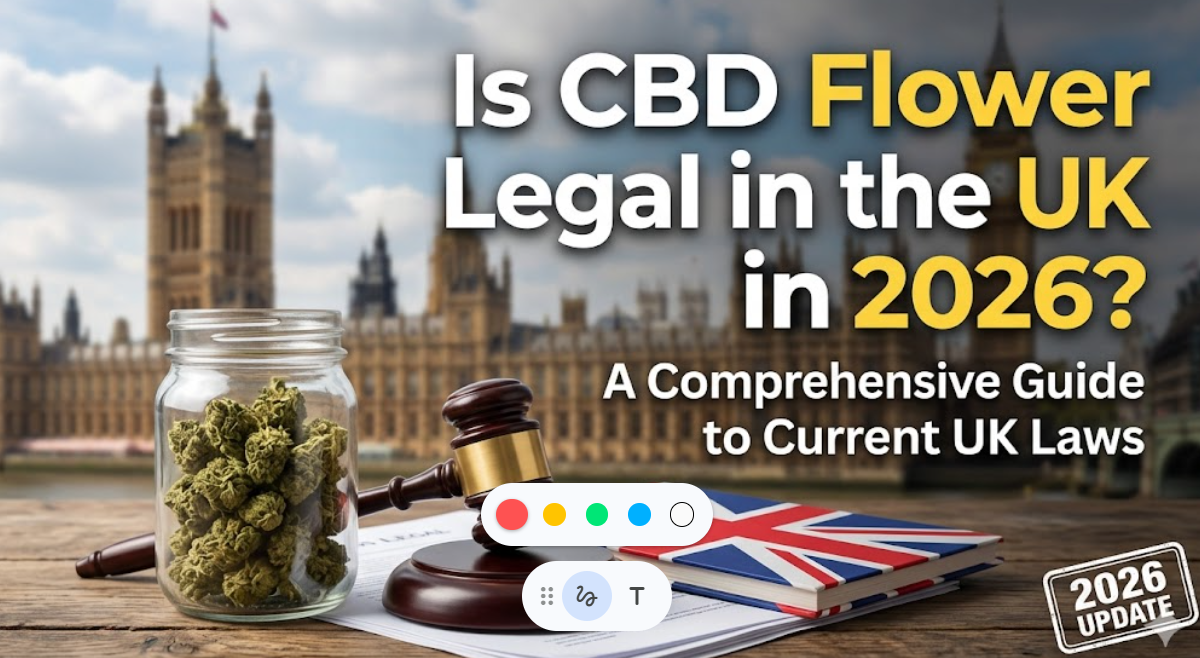
CBD flower sits in one of the most debated corners of UK drug law. Buyers, retailers, and even some legal professionals disagree on where the line is, and that disagreement has real consequences for anyone looking to buy or sell it. If you’re searching for premium CBD flowers in the UK, the first thing you need to understand is that the legal position here is not the same as it is in most of Europe, and it has not meaningfully changed in 2026 despite growing consumer demand.

The short answer is this: CBD flower is not clearly legal in the UK. It exists in a space where the law says one thing, a major court ruling introduces serious nuance, and enforcement sits somewhere in between. Whether you’re a consumer, a retailer, or simply curious, understanding how those three elements interact is what matters.
Those researching CBD flowers often encounter confident claims from retailers that their products are fully legal because they come from EU-approved hemp strains with THC content below 0.2%. That claim is incomplete, and in some cases outright misleading. The THC percentage threshold applies to hemp cultivation licensing, not to the legal status of the flower itself once harvested.
What UK Law Actually Says?
The Misuse of Drugs Act 1971 is the foundation. Under this legislation, cannabis is a Class B controlled substance. The critical point is that the Act does not distinguish between high-THC cannabis and low-THC hemp flowers when it comes to the flower itself. Leaves and flowers from the cannabis plant, regardless of their THC content, are classified as controlled parts of the plant.
The Home Office industrial hemp licensing factsheet confirms this directly. Farmers who hold a valid cultivation licence are permitted to grow approved hemp varieties with THC content below 0.2%, but those licences specifically state that flowers and leaves are controlled materials and cannot be legally harvested or sold. After harvest, those parts of the plant must be destroyed at the licensed location or otherwise lawfully disposed of. Only seeds, fibre, and mature stalks are permitted for commercial use.
That means a retailer sourcing low-THC hemp flower, even from a fully licensed EU farm, and selling it in the UK is operating outside what the current licensing framework allows, regardless of what the lab tests show.
The 2023 Court of Appeal Ruling
In June 2023, the Court of Appeal issued a ruling that significantly complicated the above picture. The court stated that hemp flower with a THC content below 0.2% does not meet the definition of a narcotic drug. This was widely reported as a landmark decision, and for businesses in the CBD flower market it offered a meaningful reduction in criminal prosecution risk.
The ruling did not, however, legalise CBD flower. Legal experts were clear on this at the time. One Life Sciences partner at a major UK law firm explained to Business of Cannabis that the ruling does not give businesses a green light to openly trade, but it substantially reduces their risk of criminal prosecution. That is a meaningful distinction. Reduced risk is not the same as legal clearance.
As of 2026, no legislative change has followed the ruling. The Misuse of Drugs Act still classifies hemp flower as a controlled substance, and the Home Office has not updated its licensing framework to permit the sale or possession of CBD flower. The grey area exists in practice, but not in statute.
The THC Limit Confusion
Two numbers circulate widely in the CBD market and are frequently misapplied. The 0.2% THC figure is a cultivation standard. It refers to the maximum THC concentration permitted in hemp plants grown under a Home Office licence. It says nothing about the legality of finished products sold to consumers.
The figure that applies to finished CBD products sold in the UK is 1mg of THC per container, regardless of product size or volume. This applies to oils, capsules, edibles, and other ingestible or topical CBD products. It does not apply to flowers, because flower is not a licensed product category in the UK to begin with.

Confusing these two figures is common and leads many consumers to assume that any hemp product below 0.2% THC is legal. It is not a safe assumption to make.
What the FSA Rules Mean for CBD Products
The Food Standards Agency classifies ingestible CBD products as novel foods. This means any CBD oil, capsule, or edible sold in the UK for human consumption requires FSA novel food authorisation before it reaches the market. As of 2026, the FSA review process for CBD novel food applications is ongoing, with first approvals expected later in the year.
The FSA also updated its daily consumption guidance for CBD in October 2023, reducing its recommended limit for healthy adults from 70mg per day to 10mg per day. That guidance applies to legal CBD food supplements, not to flower. Flower does not fall under FSA jurisdiction because it is not an authorised product format.
If you’re interested in how regulatory bodies approach natural wellness products more broadly, this piece on supplement sourcing and ingredient transparency covers how documentation and third-party verification are now baseline expectations in the wellness space, a standard the CBD industry is held to as well.
Legal Alternatives That Are Clearly Compliant
For consumers who want CBD without legal ambiguity, several product formats sit well within UK law when properly produced and labelled.
CBD oils derived from cold-pressed hemp seed oil are excluded from novel food regulations entirely, making them the most straightforward option. CBD isolate-based products, topicals, and vape liquids that contain no detectable THC and carry a current certificate of analysis from an accredited third-party laboratory sit on firmer legal ground than flower.
Certificates of analysis matter significantly here. A credible COA covers cannabinoid profile, THC concentration, pesticides, heavy metals, and microbiological safety. Any retailer unwilling to share batch-specific lab documentation is not worth buying from. The Centre for Medicinal Cannabis has published research on UK CBD market quality, finding significant variation in product accuracy across the industry. Independent lab testing remains the most reliable filter for identifying products that match their labels.
What to Expect in the Rest of 2026?
No legislative change is expected to clarify the legal status of CBD flower before the end of 2026. The FSA novel food review process, which covers ingestible CBD products rather than flower specifically, is moving forward, but flower legalisation is a separate question that would require Home Office action rather than FSA approval.
Consumer interest in CBD continues to grow. As noted in this overview of how everyday services are moving online, the shift toward accessible and digitally verifiable products is changing how people approach health decisions, and CBD is part of that shift. The demand is there. The legal framework has not caught up.
For now, the practical position is this: CBD flower remains illegal under the Misuse of Drugs Act, the 2023 Court of Appeal ruling reduced prosecution risk but did not change the law, and no compliant licensed pathway exists for selling or possessing CBD flower in the UK. Stick to documented, lab-tested CBD oils and topicals if legal clarity matters to you.
Leave a Reply