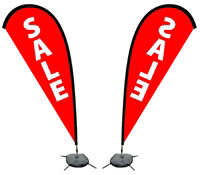
Cafes, food trucks and market stalls all face the same challenge: getting noticed among the noise of a busy strip, a crowded market, or a one-day festival. Signage that sits flat against a wall or a table often gets missed. Teardrop flags solve this differently. Their tapered shape catches the wind and moves, which naturally draws the eye of people walking or driving past.
Why the Shape Works
A teardrop flag is made from a fabric panel stretched over a flexible pole. When there’s a breeze, the fabric flutters and shifts, creating movement that static signs can’t match. For a food or beverage business, that movement is often what separates a venue people notice from one they walk straight past.
Beyond the shape, the materials matter. Quality teardrop flags are made from UV-resistant, weatherproof fabric, so a flag placed outside a cafe on a hot day or a market stall in light rain won’t fade or lose its colour after a few uses. The printing process also plays a part here, since flags with poor print quality tend to look washed out within a season, which defeats the purpose of having one in the first place.
Where They Get Used
Food and beverage businesses tend to use teardrop flags in a few common ways.
Cafes and Restaurants
A flag outside the entrance can mark daily specials, opening hours, or simply help people find the door from further down the street. Some venues keep a flag out permanently and just change what it says with the seasons.
Food Trucks and Market Stalls
Because the pole and base pack down quickly, a food truck can set up at a weekday location, then move to a weekend market with the same flag. This makes teardrop flags a practical option for any business that doesn’t operate from one fixed spot.
Festivals and Events
At larger outdoor events, a flag helps a stall stand out among rows of similar setups. A ground spike base works well here, particularly on grass or soft ground where other base types aren’t practical.
Breweries and Bars
Flags aren’t only for outdoor use. Inside a venue, a flag near the entrance can point to a tap list, a trivia night, or a live music event, doing the same job as a poster but with more visibility across a room.
Choosing the Right Size and Base
Teardrop flags usually come in a few standard sizes, and the right one depends on where it’s going. A smaller flag suits a shopfront or food truck window, where space is limited, and people will see it from close range. A larger flag makes more sense at an open festival site or market, where visibility from a distance matters more than compact placement.
The base is just as important as the size. A few common options:
- Ground spike, for grass or soft outdoor ground
- Cross base, for hard surfaces like pavement or tarmac
- Water-fillable base, for extra stability in exposed or windy spots
- Wall mount, for fixed shopfront placement
Getting the base wrong is a common mistake. A cross base on soft grass won’t hold as well as a spike, and a spike is no use on a concrete forecourt.
Getting the Design Right
Because a flag is usually read at a glance from a distance, the design works best when it’s kept simple. A business name, a logo, and one clear message is usually enough. Trying to fit too much text onto a flag makes it harder to read from further away, which reduces the flag’s usefulness rather than adding to it.
Some businesses order a small set of flags with different messages, one for daily specials and another for events, and swap them on the same pole and base as needed. This keeps the setup consistent while allowing the message to change with what’s happening on any given day.
Single-Sided or Double-Sided Printing
Teardrop flags can be printed on one side or both, and the right choice depends on where the flag will sit. A flag placed against a wall or in a shop window only needs one printed side, since the back won’t be seen. A flag standing in open space, such as at a market stall or festival site, is usually better double-sided, so the message reads clearly no matter which direction someone is approaching from. Single-sided flags typically show a mirrored version of the design on the reverse, which is worth knowing before finalising artwork, particularly if the design includes text.
Durability and Practical Considerations
How long a flag lasts depends on the fabric weight, how often it’s exposed to direct sun, and how it’s stored between uses. In particularly exposed locations, such as beachside cafes or open showgrounds, a vented fabric option is worth looking at. The small holes allow the wind to go through the flag rather than putting strain on the pole, which minimises the chance of damage in gustier conditions.
It’s also worth checking local council rules before placing a flag on public footpath space outside a fixed premises. Requirements vary between councils, and some retail strips have specific rules around outdoor signage.
In Summary
For food and beverage businesses that need to be seen, whether from a fixed location or on the move, teardrop flags offer a straightforward way to add visibility without a large setup. Getting the size, base and design right makes the difference between a flag that works and one that ends up ignored.
If you’re weighing up teardrop flags for your cafe, food truck or next market stall, our team can talk you through sizing, base options and turnaround times for your specific setup. Get in touch with Selby for a quote.




Leave a Reply