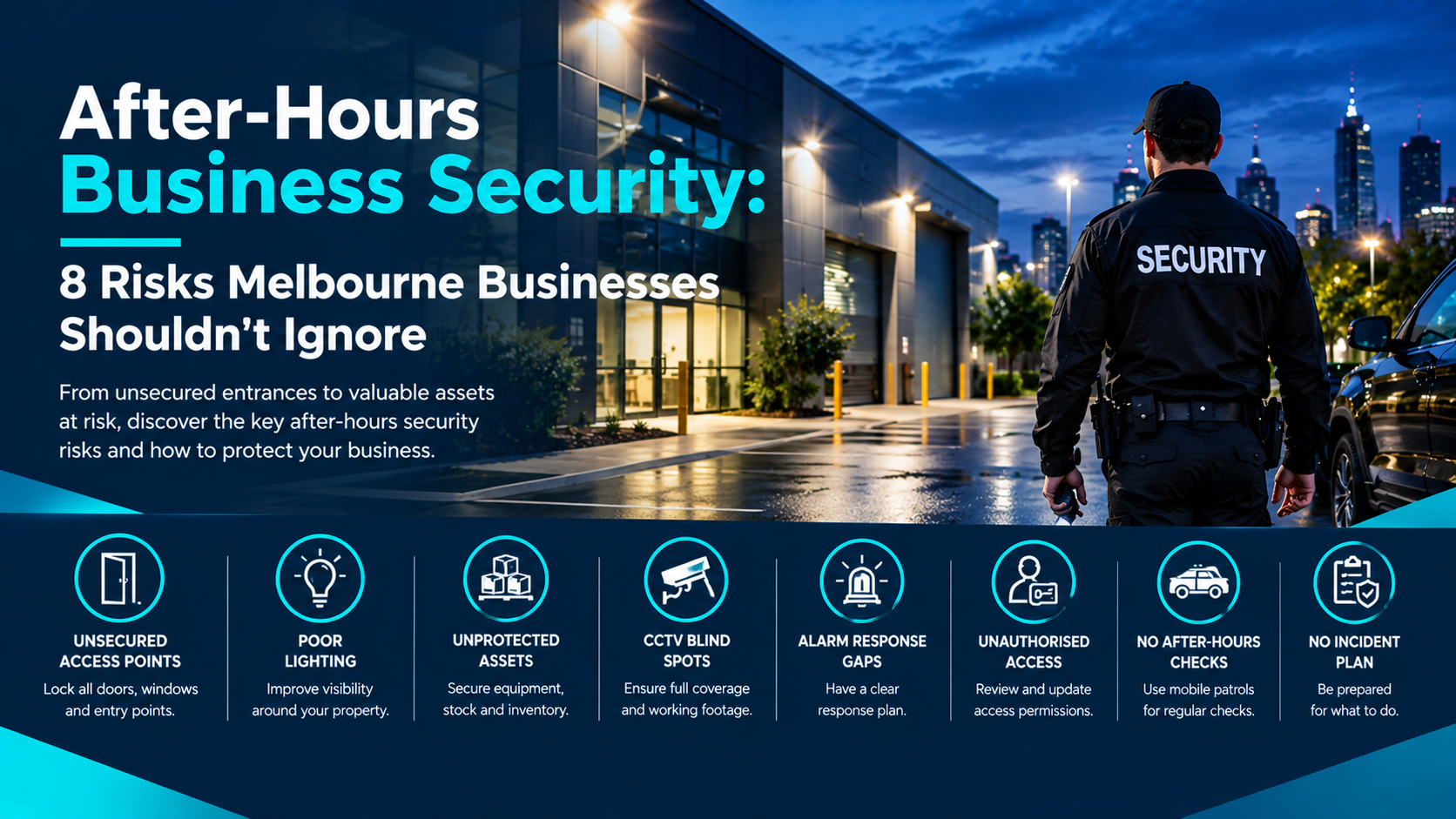
When employees leave for the day, business security shouldn’t stop. Offices, warehouses, retail stores and commercial properties can face security challenges after closing time. Unsecured entrances, equipment theft and undetected damage may go unnoticed until the next working day.
For Melbourne businesses, effective after-hours business security involves more than locking the front door. Identifying vulnerabilities, protecting valuable assets and establishing clear response procedures can help reduce security risks.
Here are eight after-hours security risks Melbourne businesses should address.
1. Unsecured Doors, Windows and Access Points
Businesses may secure their main entrance but overlook rear doors, accessible windows, emergency exits or warehouse loading bays. These less-visible access points can create security weaknesses when premises are unattended.
How to reduce the risk:
- Check all external doors, windows and gates before leaving.
- Secure loading bays and storage areas.
- Restrict access to keys, swipe cards and entry codes.
- Assign responsibility for the final security inspection.
A consistent closing routine helps ensure important tasks aren’t forgotten. Businesses can also review their security services in Melbourne to identify measures suited to their premises.
2. Poor Security Lighting
Dark entrances, parking areas and building perimeters can make suspicious activity harder to identify. Poor lighting may also create safety concerns for employees working outside standard business hours.
Inspect your property after dark and identify areas with limited visibility, particularly rear entrances, delivery zones and external storage spaces.
Consider installing suitable security lighting and checking existing fixtures regularly. Lighting works best alongside other security measures rather than as a standalone solution.
3. Unprotected Equipment and Inventory
Computers, tools, machinery and retail stock can represent significant business investments. Leaving valuable items in accessible locations may increase the impact of a security incident.
Warehouses face additional challenges because of the volume of goods moving through loading areas.
To improve warehouse security, store high-value items in secure areas, maintain accurate inventory records and restrict access to storage rooms. Retail businesses should keep valuable merchandise away from unsecured entrances where practical.
Establish clear procedures for securing deliveries and checking stock before closing. These simple measures can help businesses identify discrepancies and reduce avoidable risks.
4. CCTV Cameras With Blind Spots
Installing CCTV cameras doesn’t automatically mean a property is adequately protected. Cameras may have blind spots, obstructed views, poor night-time visibility or recording problems.
Businesses should regularly check that cameras cover important entrances, loading areas and other vulnerable locations.
Review your CCTV system by checking:
- Whether key entry points are visible.
- Whether lighting supports useful footage.
- Whether recordings can be retrieved when required.
- Whether authorised staff know how to access the system.
Professional CCTV monitoring services may complement a broader security strategy. Businesses should clarify whether their chosen service includes live monitoring, event-based alerts or other response arrangements.
5. Alarm Systems Without a Response Plan
A security alarm can alert the appropriate people to a possible incident, but its effectiveness depends on what happens next. Outdated contact details or unclear responsibilities can delay a response.
Test alarm systems according to the provider’s recommendations and keep emergency contact information current. Ensure authorised employees understand how to operate the system.
Businesses should also establish a clear procedure for dealing with alarm activations outside operating hours.
Depending on the property’s requirements, alarm response services may help arrange an appropriate response when an alert requires investigation. Confirm the service’s scope and understand who receives alerts and what actions may follow.
6. Unauthorised Access After Closing
Former employees, contractors or visitors may retain keys, access cards or entry codes after their authorised access has ended. Shared codes can also make it difficult to determine who entered a building.
To strengthen commercial security, review access permissions whenever employees leave or contractors finish a project.
Where possible, use individual access credentials and maintain records of issued keys and cards. Establish a process for reporting lost credentials and updating permissions promptly.
Businesses receiving after-hours deliveries or maintenance visits should also define who can approve entry and which areas visitors may access.
7. No Security Checks Overnight
A property may appear secure when employees leave but experience an incident several hours later. Without suitable monitoring or physical checks, damage or suspicious activity may remain unnoticed until morning.
The right approach depends on the property’s size, location and risk profile. Some businesses may rely on alarms and CCTV, while larger commercial sites may need additional physical checks.
Mobile patrol security can provide another layer of protection through property inspections and reporting, depending on the agreed arrangements.
Professional mobile patrol security services may suit businesses requiring after-hours checks of entrances, parking areas, perimeters or other agreed locations.
When comparing security companies in Melbourne, ask how patrols are scheduled, what officers inspect and how concerns are documented.
8. No Clear Incident Response Procedure
Even well-maintained security systems cannot guarantee that incidents will never occur. Businesses should prepare for attempted break-ins, damaged doors, suspicious vehicles and unexpected alarm activations.
An effective response plan should include:
- Current emergency and after-hours contact details.
- Clear instructions for reporting suspicious activity.
- Defined responsibilities for managers and authorised personnel.
- Procedures for documenting incidents and reviewing relevant footage.
- Guidance on when to contact emergency services.
Employees should never put themselves at risk by confronting suspected intruders. If there is an immediate threat to life or safety, contact emergency services.
Review procedures after an incident or significant change to the premises to identify improvements.
After-Hours Business Security Checklist
Before leaving your premises, make sure:
- All external doors, windows and gates are secured.
- Valuable equipment and stock are stored appropriately.
- Security lighting is functioning.
- CCTV and alarm systems are operating as expected.
- Access permissions are up to date.
- After-hours contact details are accurate.
- Staff know how to report security concerns.
Assign responsibility for the final inspection and update the checklist whenever your business operations or premises change.
Protect Your Melbourne Business After Hours
Effective after-hours business security combines physical safeguards, appropriate technology and clear procedures. The right approach depends on your property, operating hours and potential risks.
Alfa Security Services provides security solutions for Melbourne businesses, including security guards, mobile patrols, CCTV monitoring and alarm response.
Reviewing your current arrangements can help identify vulnerabilities and determine which measures are appropriate for your premises.
Don’t wait for a security incident to reveal a weakness. Review your after-hours security arrangements today to help protect your people, property and business assets.

Leave a Reply