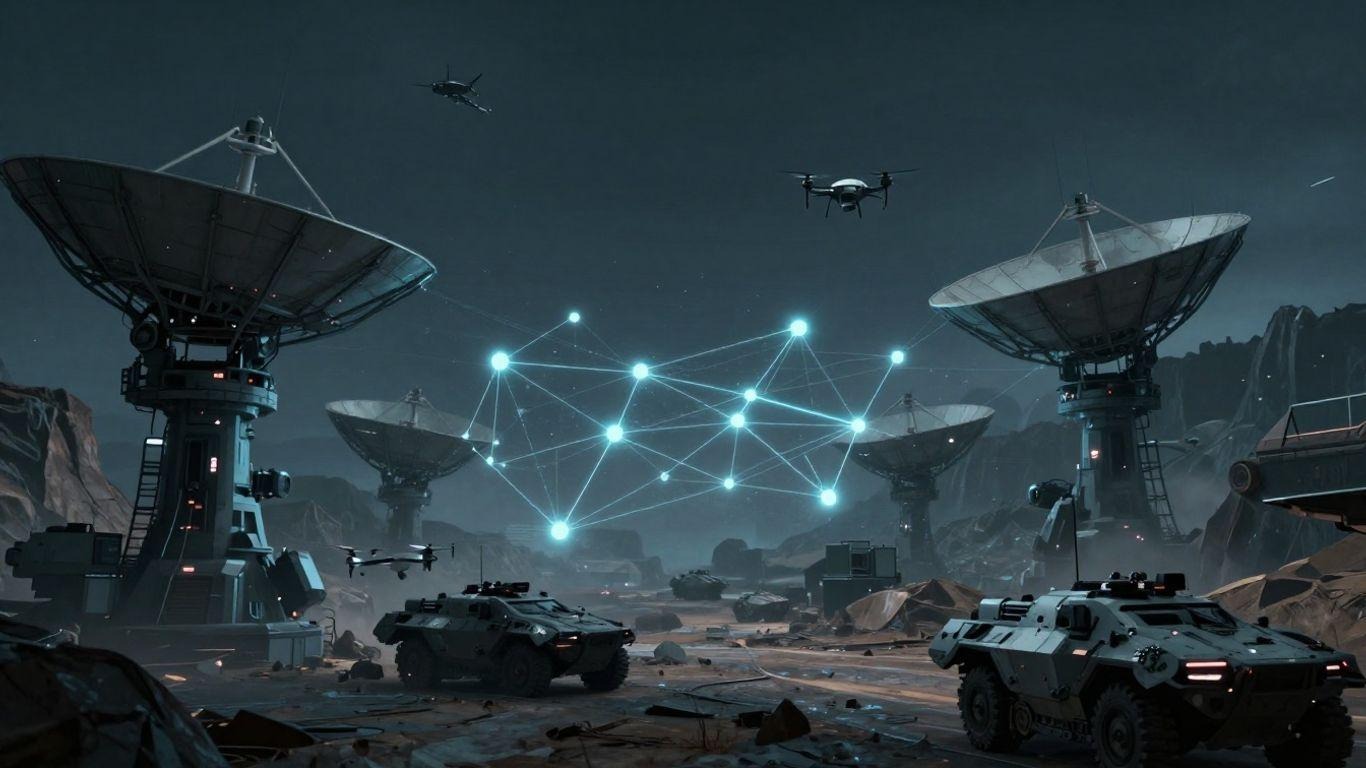
The Imperative for Next-Generation Tactical Communications
The modern battlefield is a complex, data-driven environment. Connectivity isn’t just helpful; it’s the core of operations. While platforms and sensors have gotten smarter, the communication systems linking them haven’t always kept up. This creates a gap between what forces need and what older radios can provide. Today’s missions depend on constant data flow, from video feeds to autonomous systems, making this gap a real risk.
Forces are dealing with crowded airwaves, new electronic warfare (EW) threats, and tricky line-of-sight issues, especially in cities. Old radios just can’t handle the demands of high-bandwidth intelligence, surveillance, and reconnaissance (ISR) or the needs of autonomous platforms. This is why resilient, adaptive communications are becoming absolutely critical for mission success. The need for next-generation tactical communications is clear.
The future battlefield demands communication systems that can adapt and survive. Without this, operations are at a significant disadvantage. We’re seeing a clear push towards systems that can handle the chaos and complexity of modern conflict, moving beyond the limitations of what was once considered standard. This evolution is not just about upgrading hardware; it’s about rethinking how information flows.
Bridging the Gap Between Requirements and Legacy Systems
Many military forces are still relying on older communication gear. These legacy systems, while familiar, often lack the bandwidth, flexibility, and security needed for today’s operations. They weren’t designed for the constant stream of data, the sophisticated jamming techniques, or the sheer volume of connected devices we see now. Trying to force these older systems to meet new demands is like trying to run modern software on an ancient computer – it’s slow, unreliable, and often impossible.
This gap means that critical information can be delayed or lost, impacting decision-making and operational effectiveness. Imagine trying to coordinate a complex maneuver with intermittent radio contact or outdated intelligence. It’s a recipe for disaster. The challenge is to integrate new capabilities without completely abandoning existing investments, a difficult balancing act for any military.
The push for advanced communication capabilities is driven by the reality of modern conflict, where information superiority is as vital as physical superiority. Legacy systems, by their nature, struggle to keep pace with this evolving threat landscape.
Challenges in Contested Environments
Battlespaces today are heavily contested. This means adversaries are actively trying to disrupt communications through jamming, spoofing, and other electronic warfare tactics. Think of it as a constant electronic fight happening alongside the physical one. Signals can be drowned out, rerouted, or even turned against friendly forces. This makes maintaining a clear and secure communication channel incredibly difficult.
Beyond electronic threats, physical obstacles like buildings, terrain, and even weather can block signals. Traditional line-of-sight radios struggle in urban environments or mountainous regions. The need for communications that can work around these problems, finding alternative paths or using different frequencies, is paramount. This is where the concept of adaptive networks really comes into play.
- Spectrum congestion: Too many signals fighting for limited airwaves.
- Electronic warfare: Active attempts to disrupt or deceive communications.
- Physical obstructions: Terrain, buildings, and weather blocking signals.
- Interoperability issues: Different systems are unable to talk to each other.
These challenges highlight why simply having a radio isn’t enough. The communication system must be intelligent, resilient, and capable of operating effectively even when under attack. The evolution of battlefield communication infrastructure is directly tied to overcoming these persistent issues.
The Rise of Adaptive and Distributed Networks

Mobile Ad-Hoc Networks as a Foundation
The modern battlefield demands constant connectivity, but traditional communication systems often struggle. This is where Mobile Ad-Hoc Networks, or MANETs, come into play. They form the backbone of many next-generation tactical communications systems. Unlike networks that rely on fixed towers or infrastructure, MANETs are decentralized. Every device in the network can act as both a user and a signal booster.
This self-forming capability means the network can adapt on the move. If one node goes down, others can quickly reroute traffic. This makes MANETs incredibly resilient, especially in environments where infrastructure is damaged or non-existent. The ability of MANETs to maintain communication links without central control is a game-changer for battlefield operations.
These networks are built to be flexible. They can expand or contract as needed, adding or removing nodes without disrupting service. This adaptability is key to keeping forces connected in unpredictable situations. The core idea is to create a communication mesh that can survive and function even under pressure.
Self-Forming and Self-Healing Architectures
Building on the MANET concept, self-forming and self-healing architectures take adaptability to the next level. These systems are designed to automatically establish connections and repair themselves when disruptions occur. Think of it like a living network that constantly adjusts to maintain its integrity.
When a communication path is blocked or a device fails, the network doesn’t just stop. Instead, it intelligently finds new routes for data. This is crucial for maintaining situational awareness and command and control in contested areas. The network actively works to keep itself operational.
This intelligent behavior means less reliance on manual intervention. Operators can focus on their mission, not on troubleshooting communication issues. The network handles the complexities of maintaining connectivity, making it a more robust solution for the dynamic battlefield. This adaptive nature is a hallmark of modern tactical communications.
Overcoming Electronic Warfare and Obstacles
Electronic Warfare (EW) poses a significant threat to battlefield communications. Jamming, spoofing, and other EW tactics aim to disrupt or deny communication links. Adaptive and distributed networks are specifically designed to counter these threats.
By using intelligent waveforms and distributed nodes, these networks can dynamically change their frequencies, transmission patterns, and routing. This makes it much harder for EW systems to target and disrupt them effectively. The network can sense interference and react in real-time.
Beyond EW, these networks also overcome physical obstacles. Urban environments, dense foliage, and mountainous terrain can block traditional line-of-sight communications. The mesh nature of MANETs allows signals to hop from node to node, finding paths around these obstructions. This ensures that communication lines remain open, even when direct paths are impossible. The goal is always to maintain a reliable connection, no matter the challenge.
Integrating Advanced Technologies for Enhanced Situational Awareness
AI and Machine Learning in Command and Control
Artificial intelligence (AI) and machine learning (ML) are changing how command and control (C2) works on the battlefield. These technologies help sort through massive amounts of data, spotting patterns and threats that humans might miss. This means commanders get clearer, faster insights. AI and ML are key to making sense of the chaos. They help predict enemy movements and suggest optimal responses, making operations more efficient.
Extending Sensor Capabilities Through Night Vision Devices
Modern night vision devices are becoming more than just tools for seeing in the dark. They are turning into communication hubs and sensors themselves. By linking these devices into the wider network, soldiers get a better picture of what’s happening around them. This extends the reach of sensors and improves overall situational awareness. Think of it as giving every soldier a small, mobile sensor that feeds information back to the team. This constant flow of data helps everyone make better decisions.
Reducing Operator Workload with Cognitive Systems
With all the new technology, there’s a risk of overwhelming the soldier. Cognitive systems, powered by AI, aim to fix this. They manage the flow of information, showing the soldier only what’s important, when it’s important. This reduces mental strain and allows soldiers to focus on their mission. The goal is to make technology work for the operator, not the other way around. This smart filtering of data is vital for keeping soldiers effective in high-pressure situations.
Lessons from Global Conflicts and Modernization Efforts
Interoperability Challenges in Russian Communications
Recent conflicts have really highlighted how tricky it can be when different communication systems can’t talk to each other. Take Russia, for example. They’ve been trying to update their gear, but getting new radios to work with older ones has been a real headache. This means troops sometimes have to send sensitive information in the clear between systems, which is a big security risk. It’s a tough problem, and it shows that just having new tech isn’t enough if it can’t integrate properly. This issue with interoperability is something many militaries are grappling with.
The Role of Commercial SATCOM Systems
We’ve seen how commercial satellite systems, like Starlink, have become super important for battlefield communications. They offer wideband links over long distances, which is great for things like drone feeds and connecting different units. However, relying on systems not under direct military control brings its own set of worries. The idea of needing sovereign control over these vital communication links is now a major talking point. It’s a trade-off between rapid deployment and long-term strategic independence.
Robustness of Legacy Systems Against Electronic Warfare
It’s funny, but sometimes older tech proves its worth. In some recent conflicts, older radios, like the SINCGARS designed way back in the 1980s, have shown surprising toughness against enemy jamming. These systems, along with other NATO-standard radios, have held up better than expected against modern electronic warfare. This resilience from legacy systems is a stark reminder that new isn’t always better, and proven designs can still have a place on the modern battlefield. It suggests that a mix of old and new, carefully chosen, might be the way forward.
Key Enhancements for Resilient Tactical Networks

Ensuring Communication Security and Transmission Security
Keeping communications secure is a big deal on the modern battlefield. It’s not just about scrambling messages; it’s about making sure the enemy can’t even tell who’s talking to whom or what they’re saying. This means strong encryption is a must, but also thinking about how signals are transmitted. Transmission security, or TRANSEC, is about hiding the fact that communication is even happening. Think of it like whispering in a crowded room versus shouting – both can be secure, but one is much harder to detect.
Protecting the data itself is only half the battle; hiding the communication’s existence is equally vital. This involves techniques like frequency hopping, spread spectrum, and burst transmissions. These methods make it incredibly difficult for adversaries to intercept, locate, or jam signals. Without robust TRANSEC, even the strongest encryption can be bypassed if the enemy can simply shut down the communication link or gather intelligence from the signal’s characteristics.
The Importance of Non-GPS-Reliant Waveforms
Relying solely on GPS for timing and positioning is a risky game. GPS signals can be jammed, spoofed, or simply unavailable in certain environments, like deep canyons or dense urban areas. This is where non-GPS-reliant waveforms come into play. These advanced waveforms build timing and synchronization directly into the communication signal itself, making them independent of external navigation systems. This independence is critical for maintaining network operations when GPS is compromised.
These waveforms often incorporate sophisticated algorithms that allow radios to synchronize with each other using only the radio signals. This self-synchronization capability means that even if GPS goes dark, the network can continue to function. It’s like having a built-in compass and clock for your communication system, removing a major vulnerability that adversaries could exploit. This resilience is a key factor in modern tactical communications.
Adapting to Electronic Warfare Threats
Electronic warfare (EW) is a constant challenge, with adversaries actively trying to disrupt, deceive, or deny friendly communications. To counter this, tactical networks need to be adaptive. This means the communication systems must be able to sense the electromagnetic environment, identify threats, and automatically adjust their waveforms, frequencies, or transmission power to maintain connectivity. It’s a continuous cat-and-mouse game where the network must stay one step ahead.
Adaptive waveforms are designed to be agile. They can rapidly change their characteristics to avoid jamming or interference. This might involve switching to a different frequency band, changing modulation schemes, or even altering the signal’s structure on the fly. The goal is to make the communication link as robust and survivable as possible, even when facing sophisticated EW attacks. This adaptability is not just a nice-to-have; it’s a necessity for mission success.
Global Initiatives in Battlefield Communication Infrastructure
Australia’s Integrated Battlefield Telecommunications Network
Australia is actively upgrading its battlefield communication systems. The Integrated Battlefield Telecommunications Network, or I-BTN, represents a significant step forward. This network aims to provide deployed forces with more voice, data, and video services than previously possible. Boeing Defence Australia is a key player, working on continuous capability enhancements to keep the I-BTN resilient against new threats. They are investing in technology refreshes and adding new features to meet evolving operational needs.
One notable addition is the Rapid Tactical Router (RAPTR). This portable router, weighing just 3.3kg, can be packed into a small case. It quickly establishes connections using satellite communication, radio, voice over internet protocol, or even the public internet. The Australian Army has also acquired various L3Harris radios, including handheld and manpack models, under Project Land 200. L3Harris continues to support this hardware, even opening a regional support center to speed up repairs.
Australia is also looking at Project Land 4140 Tranche 1, focusing on land C4 modernization. This project seeks a partner to manage a software-heavy initiative that must integrate legacy equipment while building next-generation networks. It includes transportable SATCOM terminals, a high-capacity data network aiming for 5G-level connectivity, mobile local area networks, and network modeling tools. The goal is a more integrated and adaptable communication system for the Australian military.
European Efforts Towards Sovereign Radio Capabilities
European nations are increasingly focused on developing sovereign radio capabilities. This drive stems from a desire for greater independence in critical communication technologies, reducing reliance on external suppliers. The aim is to build robust and secure communication networks that can operate effectively in contested environments. These efforts often involve collaboration between different countries and defense companies within Europe.
Several European countries are investing in research and development for next-generation tactical radios. The focus is on creating systems that are adaptable, secure, and interoperable with allied forces. This includes developing waveforms that are resistant to electronic warfare and can operate across different frequency bands. The goal is to have communication systems that meet specific European operational requirements.
These initiatives are not just about hardware; they also involve developing secure software and network architectures. The emphasis is on creating a unified European approach to battlefield communications, ensuring that national forces can communicate effectively with each other and with NATO allies. This push for sovereign capabilities is a strategic move to maintain technological advantage and operational autonomy.
United States’ Handheld, Manpack & Small Form Fit Program
The United States’ Handheld, Manpack & Small Form Fit (HттаSF) program is a major initiative to modernize tactical communication systems for its warfighters. This program aims to provide soldiers with advanced, lightweight, and interoperable communication devices that can be easily integrated into their gear. The focus is on delivering cutting-edge capabilities in a compact form factor, improving situational awareness and command and control on the battlefield.
HттаSF covers a range of radio systems, from individual soldier-worn radios to manpack units and smaller form-factor devices for various platforms. The program emphasizes software-defined radios, allowing for greater flexibility and adaptability to changing mission requirements and evolving threats. It also seeks to improve data throughput, network connectivity, and resistance to electronic warfare.
This initiative is critical for maintaining the U.S. military’s communication edge. By fielding advanced HттаSF systems, the U.S. aims to ensure that its forces can communicate reliably and securely in any operational environment. The program represents a significant investment in the future of tactical communications, supporting the warfighter with the best available technology.
Future Trajectories in Military Communications
Continuous Technology Refreshment Strategies
The battlefield is always changing, and so must our communication tools. Sticking with old gear just won’t cut it anymore. Forces need a steady stream of updated technology to stay ahead. This means not just buying new radios every few years, but having a plan to integrate them smoothly. Think of it like upgrading your phone – you don’t wait until it’s completely broken; you plan for the next model. This continuous refresh keeps our communication systems sharp and ready for whatever comes next.
The Role of Portable Routers and Network Integration
Imagine a battlefield where every soldier’s device can talk to any other, no matter what. That’s the promise of portable routers and better network integration. These devices act like mini-hubs, creating flexible networks on the fly. They help connect different types of radios and systems, making sure everyone’s on the same page. This kind of integration is key for making sure all our advanced tech, from drones to sensors, can actually talk to each other. It’s about building a connected force, not just a collection of individual gadgets.
Advancements in Quantum Encryption and Cognitive Radio
Security is a big deal, and that’s where quantum encryption comes in. It’s like a super-secure lock for our messages, making them almost impossible to crack. Then there’s cognitive radio. This tech is smart; it can figure out the best way to send a signal, even in a crowded or jammed environment. It adapts on the fly, finding clear channels and avoiding interference. Combining these two – super-secure communication with smart, adaptive radios – is the future. It means our messages get through, and they stay private, no matter how tough the electronic warfare gets. This focus on advanced communication systems is vital for future operations.
Looking Ahead
The battlefield of tomorrow will be defined by how well forces can communicate. As technology moves forward, so must our communication systems. We’re seeing a big push towards networks that can adapt on the fly, handle more data, and stay connected even when things get tough. This means moving beyond old ways of doing things and embracing smarter, more flexible solutions. The goal is to keep everyone connected, informed, and able to act fast, no matter the situation. It’s a complex challenge, but one that’s absolutely necessary for future success on any mission.




Leave a Reply