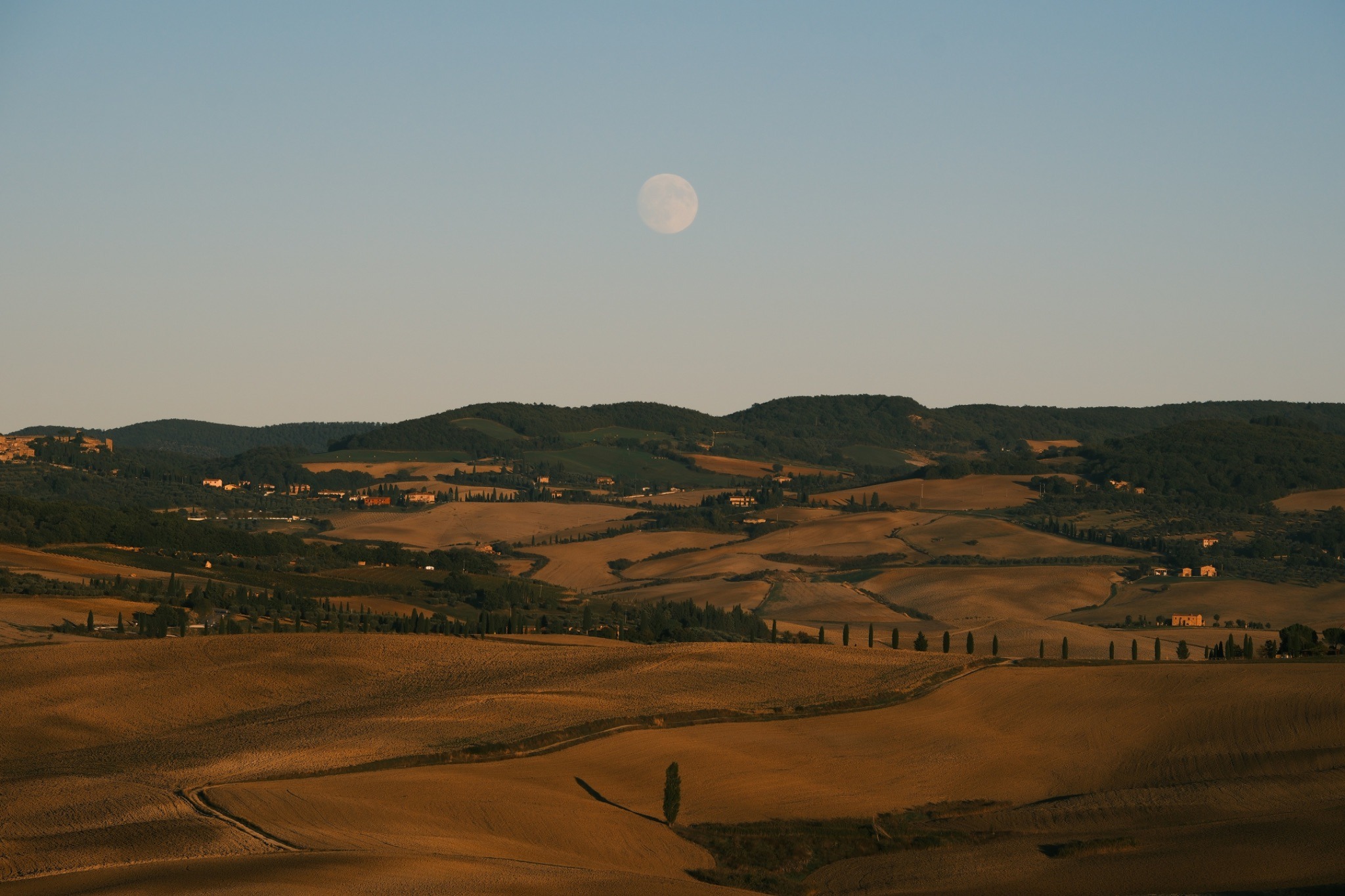
The land doesn’t open in a straight line. It curves, rises slightly, then stretches outward in ways that don’t feel measured. A row of trees appears, then another behind it, then something further that fades before you can hold it clearly.
Colour shifts with the light. Warm tones at first, then something softer where shadow settles. The surface doesn’t stay the same from one step to the next.
Nothing feels fully still.
Where the Lines of Trees Begin
Tuscany gathers through repetition that never quite repeats. Cypress trees rise in rows, though each line bends slightly, adjusting to the land beneath it.
The ground feels steady, though it changes in small ways. Dust, then firmer earth, then something smoother where the path has been worn down.
Printed across a folded brochure resting on a low wall, tours to Italy appears among other text, then disappears as the paper shifts in the breeze.
The landscape continues.

What the Fields Suggest
The fields don’t hold a single pattern. One stretch appears even, then breaks into smaller sections that don’t align perfectly.
You notice changes without deciding to. A curve in the land, a shadow that moves slightly, a line that almost repeats but doesn’t.
Along a weathered sign near the edge of the path, Portugal tours sits among faded lettering, then blends back into the surface without standing out.
Nothing interrupts the view.

When the Horizon Tilts
The direction doesn’t stay fixed. The land rises gently, then lowers again, shifting the horizon without marking when it changed.
You walk forward, though it doesn’t feel like moving toward anything specific.
The space adjusts around you.
The Point Where It Softens
At some stage, the texture begins to change. The ground feels less defined. The lines of trees thin out.
You don’t notice when it begins. Only that it already has.
The air carries something different here. Less warmth, more movement.
Where the Edge Appears
The Algarve doesn’t gather gradually. It breaks open. The land gives way to stone, then to something that drops away more sharply than expected.
The cliffs don’t form a continuous line. They extend, then break, then return again further along.
You don’t see the full edge at once.
What the Surface Gives Back
Rock replaces soil. The texture feels rougher, less even underfoot.
The colour shifts again. Pale stone, then darker where the surface dips, then something brighter where the light holds longer.
You notice one section, then another, though neither stays long enough to define the whole.
Between Height and Drop
Looking outward changes how the space feels. The ground doesn’t rise here—it falls away.
Distance stretches further than expected, though it doesn’t stay fixed.
You don’t measure it.
Where the View Breaks Open
Beyond the cliffs, the water extends without forming a clear boundary. The horizon appears, then softens, then returns again.
The surface doesn’t stay still. It reflects, then shifts, then breaks apart again.
You don’t follow it directly.
What Doesn’t Fit Into One Frame
The difference between the two landscapes doesn’t organise itself clearly. One feels guided by lines, the other by edges.
Still, they connect through the way they change as you move through them.
You notice it gradually.
What Returns Later
It isn’t only the images that remain. It’s the way they appeared—quietly, then fully, then gone again.
Those moments don’t form a clear sequence. They come back out of place, slightly altered.
You don’t decide which ones stay.
When the View Is Already Gone
Looking back, the details don’t return in order. The trees, the cliffs, the shifting space between them don’t form a path you can follow.
They appear in fragments. A line of cypress. A sudden drop. A stretch of light that changed everything for a moment.
You don’t try to arrange them.
They continue somewhere beyond what you remember, not as a complete scene, but as something still unfolding.




Leave a Reply