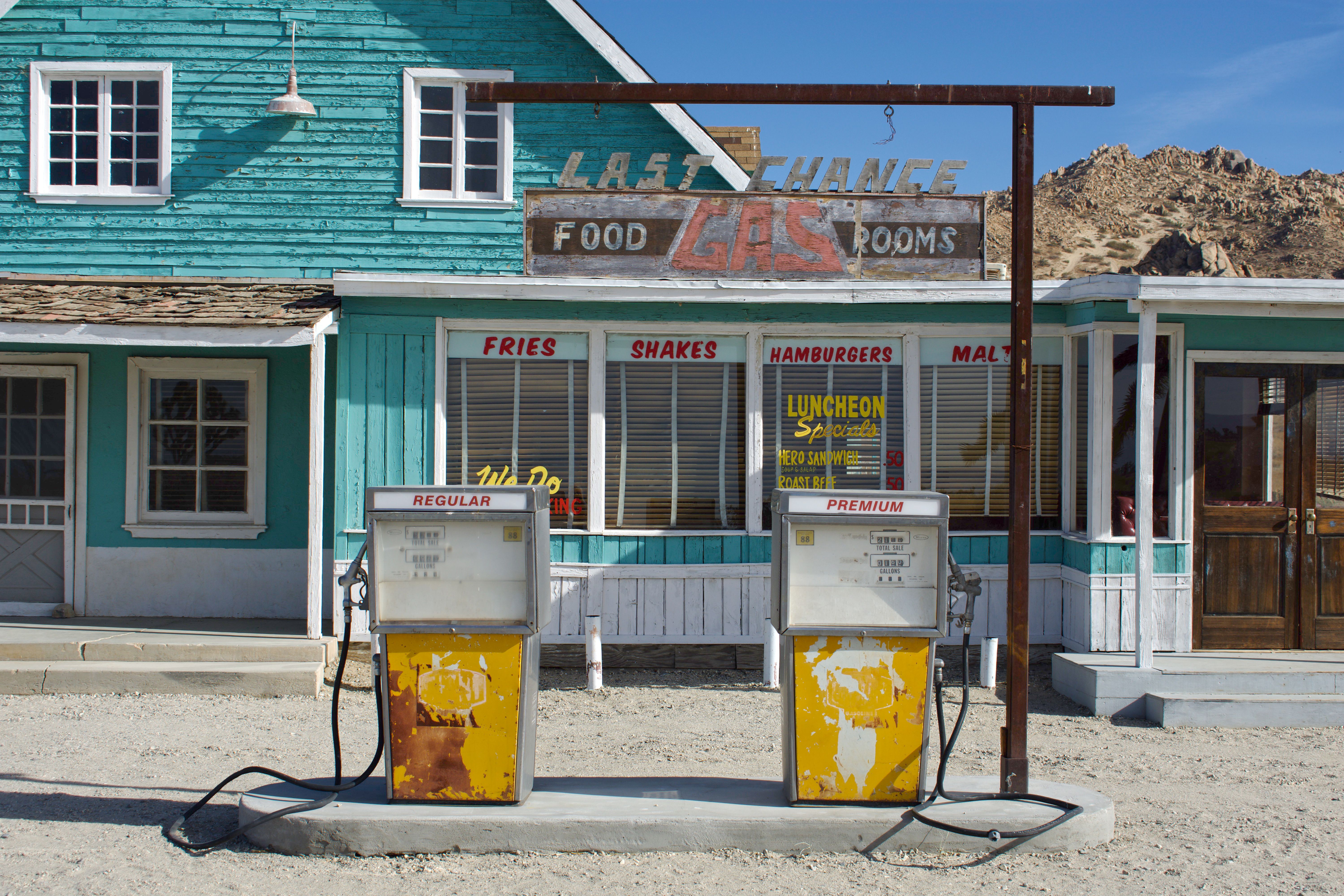
California’s rural highways hide a secret: the humble roadside stop that started as a single gas pump in the 1920s has quietly become a multi-million dollar destination. Along Interstate 5 alone, these stops now draw millions of visitors annually. But how did we get from a wooden shack selling soda to sprawling complexes with hotels, golf courses, and entertainment venues? The story involves land rushes, a highway nobody wanted to build, and one tribe’s determination to reshape its own future.
Why the Middle of Nowhere Became Prime Real Estate
Here’s what most people don’t realize about rural California: the land between major cities was never supposed to be empty. Before the highways arrived, small farming towns dotted the Central Valley, each with its own general store, church, and railroad depot. But when car travel exploded in the 1920s, those towns suddenly found themselves bypassed by travelers who wanted speed over stops.
You’ve probably noticed it yourself. Drive through the valley today and you’ll see the skeleton of a town every twenty miles or so, usually a boarded-up diner and a gas station with faded prices. These places thrived for decades, then died when the interstate system rerouted traffic. According to the California Department of Transportation, the state now maintains over 50,000 miles of highway, and the vast majority of that runs through rural land where a bathroom break is often the only reason to pull over (ca.gov, 2024).
So the economics shifted. A stop that once served twenty cars a day from a two-lane road suddenly needed to capture attention from a four-lane freeway where drivers hit 75 miles per hour. The stakes got higher, the buildings got bigger, and the competition got fiercer. That’s the pivot point where the modern rural destination was born.
The Interstate That Changed Everything
Interstate 5 didn’t just connect Northern and Southern California. It rewired the entire logic of travel in the state. Before it opened in segments through the 1960s, most coastal travelers took Highway 99, which ran through the middle of every small town. I-5 was designed to bypass all of them, running straight through farmland with exits spaced far apart.
What that did was create artificial islands of commerce. If you’re driving from Sacramento to Los Angeles, a six-hour trip, you need fuel, food, and a restroom roughly every two hours. The state knew this, and the federal government acknowledged it in a landmark study of highway travel behavior. The Library of Congress documented in 2020 that roadside service clusters became the single most reliable predictor of which rural exits prospered and which ones faded into gravel.
And here’s the twist: the businesses that survived weren’t the ones selling the cheapest gas. They were the ones that gave you a reason to stay. A restaurant with a decent salad bar beat a drive-through. A clean restroom with a flower bed beat a cinder block shack. Travelers vote with their exits, and they vote for the stop that feels like a destination rather than a necessity.
From Rest Stop to Resort
You’ve seen the transformation if you’ve ever pulled off I-5 around Corning, California. That stretch of highway, about halfway between Sacramento and Redding, has become a case study in how far the roadside stop has come. What started as a simple rest area has evolved into a full resort experience with a hotel, golf course, event center, and dining options that go far beyond a hot dog roller.
This is not an accident. The economics of rural hospitality demand it. A traveler stopping for ten minutes spends maybe $15. A traveler stopping for a night spends $200. A traveler who brings friends to a concert or a golf tournament spends $500 or more. The U.S. Department of the Interior reported in 2023 that rural tourism destinations with multiple attractions saw visitor spending grow at nearly double the rate of single-purpose stops, and the gap is widening as younger travelers plan trips around experiences rather than routes.
The smart operators figured this out early. They looked at their land, their location, and their community, and they asked a different question. Instead of “how do we get people to stop?” they asked “how do we get people to stay?” The answer shaped everything from the layout of the parking lot to the menu in the restaurant.
The Tribal Ownership Angle You Should Know About
One of the most important chapters in this story involves tribal nations. Along the I-5 corridor, several tribes have built successful hospitality enterprises on their ancestral lands, and the results have reshaped both the local economy and the travelers’ experience. The Paskenta Band of Nomlaki Indians, for instance, operates a major resort destination near Corning that includes gaming, hotel rooms, an RV park, and a golf course.
You might know the property as a Northern California casino, but it’s really a full destination in its own right. That distinction matters, because it reflects a deliberate strategy. Tribal nations recognized that a roadside stop alone couldn’t sustain long-term growth. They needed a reason for people to plan a trip, not just stumble upon it. So they layered attractions on top of one another until the stop became the destination.
The results speak for themselves. These enterprises fund tribal government services, health care, education, and cultural preservation programs. They employ local residents in good jobs with benefits. And they’ve turned a stretch of highway that travelers used to dread into a place people actually look forward to visiting. That’s a meaningful shift, and it didn’t happen by chance.
What the Next Decade Holds for Rural Stops
The roadside stop is entering another transformation, and this one is driven by technology. Electric vehicle charging stations are becoming a deciding factor for many drivers. Autonomous vehicles will eventually change how people think about long trips altogether. And the rise of remote work means some travelers aren’t passing through at all, they’re setting up camp for a week at a time.
Here’s what I’d watch for in the next ten years:
- EV charging infrastructure will become the new anchor tenant, with stops competing on charger speed and reliability just like they once competed on fuel prices.
- Lodging will shift toward extended stay options, because the person who can work from anywhere doesn’t need to rush home.
- Experiences will outrank convenience. A stop with a distillery tour or a horseback ride will win over a stop with just a clean bathroom, every single time.
- Local partnerships will matter more. The stops that feel like they belong to a place, rather than just sitting on it, will build the strongest loyalty.
The operators who survive this shift will be the ones who treat their stop as a community asset, not just a business. That means hiring local, sourcing local, and telling the story of the land they’re on. Travelers can smell the difference between a place that’s proud of where it is and a place that’s just counting the hours until closing time.
Plan Your Own Roadside Pilgrimage
If this history has you curious, the good news is that you can experience it firsthand without a big investment. Here’s how to plan a day trip that shows you the full arc of the rural stop, from the dying towns to the thriving destinations.
Start early and take the old Highway 99 for at least one stretch, just to see the difference between a highway town that got bypassed and one that got lucky. Then jump on I-5 and pick an exit with a major stop. Walk the property. Look at the license plates in the parking lot. Count how many states are represented.
Talk to a local if you can. Ask them what the stop looked like twenty years ago and what they think it’ll look like in twenty more. That conversation will teach you more than any history book, because the people who work these stops are the ones writing the next chapter. And here’s the thought I’ll leave you with: the next time you pass a lonely exit with a single gas station and a faded sign, ask yourself what it would take to turn that place into a destination. The answer might surprise you.


Leave a Reply