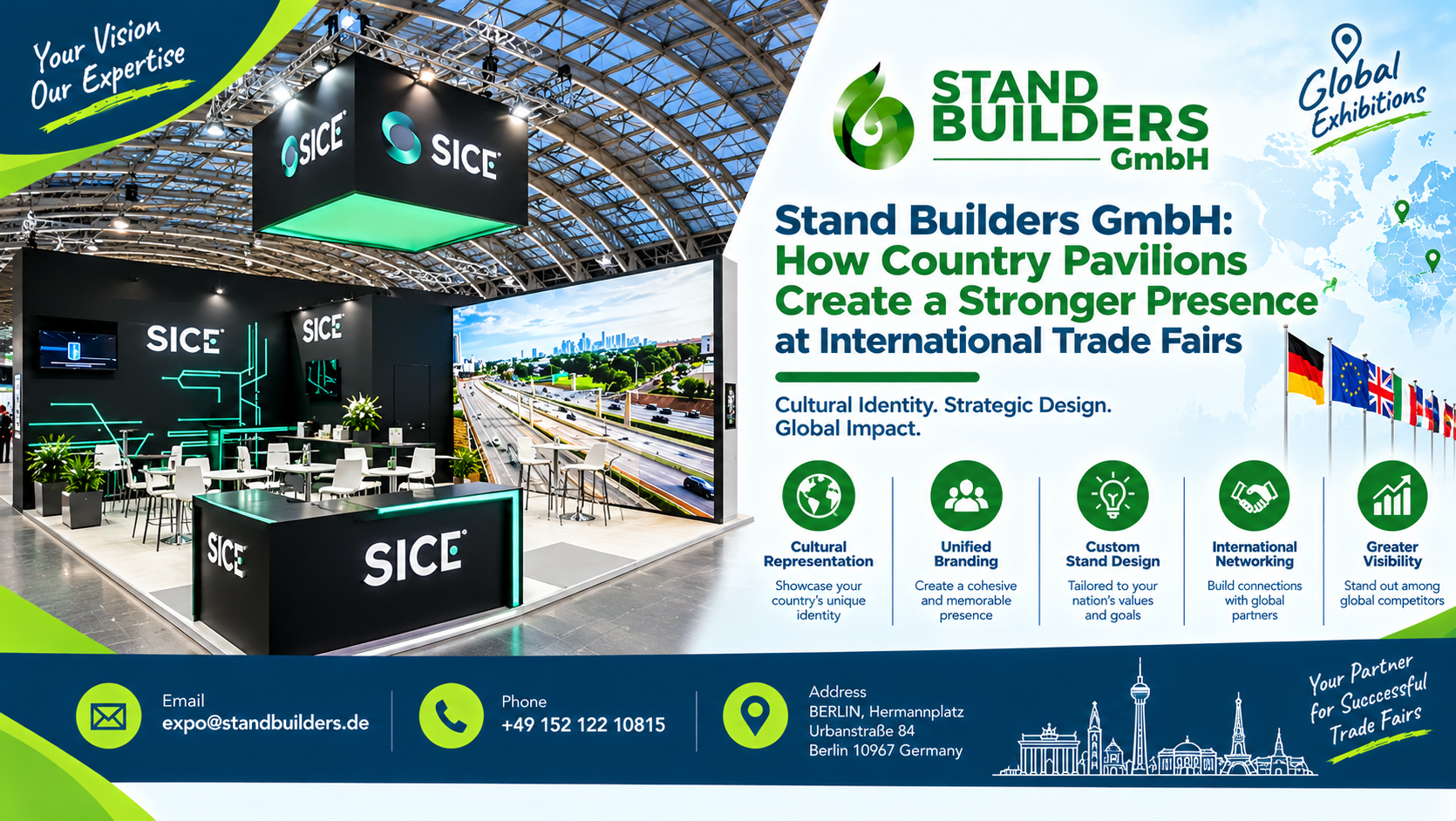
International trade fairs bring together businesses, industry associations, government representatives, and buyers from different markets. For companies exhibiting abroad, creating a recognisable presence while maintaining their individual brand identity can be challenging. This is why selecting the best exhibition stand builders in Germany involves evaluating more than visual creativity. Experience in managing complex exhibition spaces, coordinating multiple participants, and delivering functional structures is equally important. Berlin-based Stand Builders GmbH provides exhibition design and construction services that help businesses and international groups develop organised, professional trade fair environments.
The Growing Importance of Collective Exhibition Spaces
Trade fairs have traditionally provided individual businesses with opportunities to display products and establish commercial relationships. However, when several companies from the same country participate in an international event, exhibiting together can create additional advantages.
A collective exhibition space allows participating organisations to present their industries, products, and national identity within a coordinated environment. Instead of operating as unrelated exhibitors, businesses become part of a larger presentation that communicates shared commercial strengths.
This approach is particularly relevant for export promotion agencies, trade associations, industry groups, and government-supported business delegations. A well-planned collective stand can provide visitors with a convenient way to discover several companies from one market. It can also support networking activities, product presentations, and discussions about international business opportunities.
Country Pavilions: Connecting National Identity with Individual Brands
One of the most practical approaches to collective participation is the development of country pavilion exhibition stands.
These exhibition environments combine several smaller display areas within a unified architectural concept. Each participating business receives space to communicate its individual identity, while the overall pavilion reflects a shared national or regional presence.
Stand Builders GmbH develops country pavilion solutions that incorporate coordinated graphics, branding, interactive features, and dedicated spaces for business communication. The challenge is to create consistency without making every participating company appear identical.
Creating a Recognisable Pavilion Identity
A country pavilion should be identifiable from different positions within an exhibition hall. Consistent colours, architectural elements, signage, and national branding can establish a unified appearance.
However, cultural representation should remain relevant to the pavilion’s commercial objectives. Decorative elements alone cannot communicate the capabilities of participating businesses. Effective designs balance national identity with industry-specific information, ensuring visitors understand both the collective message and the individual companies represented.
Giving Each Exhibitor a Distinct Presence
Participating businesses may operate in completely different industries or offer products with contrasting display requirements.
For example, a country pavilion could include manufacturers requiring physical product displays alongside technology companies presenting digital demonstrations. The overall design must accommodate these differences while maintaining a coherent visitor experience.
Clearly defined exhibitor areas, consistent identification systems, and appropriate meeting facilities help visitors navigate the pavilion without confusion.
Why Pavilion Layouts Require a Different Planning Approach
Designing a single-company exhibition stand usually involves one brand, one decision-making team, and a defined set of presentation objectives.
Country pavilions introduce additional complexity because multiple organisations must operate within a shared environment.
Space allocation becomes particularly important. Each exhibitor needs adequate visibility, while communal areas must remain accessible.
A successful pavilion layout should consider three interconnected functions.
Visitor Circulation
Visitors should be able to move naturally between participating businesses without encountering unnecessary barriers.
Wide circulation areas, visible entrances, and logical stand arrangements make the pavilion easier to explore.
Shared Business Facilities
Meeting rooms, reception areas, information counters, and hospitality spaces can serve several exhibitors.
These shared facilities may reduce duplication and allow individual companies to dedicate more of their allocated space to products and presentations.
Technical Coordination
Different exhibitors may require electricity, lighting, screens, demonstration equipment, or additional storage.
Coordinating these requirements during the design stage helps prevent operational conflicts during installation and exhibition days.
What Makes an Exhibition Stand Contractor Suitable for Complex Projects?
Large exhibition environments require more than attractive design concepts. Contractors must understand how architectural ideas translate into structures that can be manufactured, transported, assembled, and safely operated. When evaluating an exhibition stand company, organisers should consider project management capabilities, technical expertise, production arrangements, and familiarity with exhibition venue requirements.
Stand Builders GmbH offers an integrated workflow covering initial briefing, 3D design, graphics, construction, packaging, delivery, installation, dismantling, and storage. The company also describes its in-house production facilities as part of its approach to coordinating exhibition projects.
For multi-exhibitor pavilions, this type of coordinated service can be particularly useful because changes affecting one display area may influence neighbouring spaces or shared facilities. A central project team can help maintain consistency between the approved design and the completed exhibition structure.
Choosing the Right Stand Format for Different Exhibiting Needs
Although country pavilions are designed for collective participation, businesses may require other exhibition structures depending on their objectives.
Stand Builders GmbH provides four principal stand solutions, each suited to different presentation requirements.
| Stand type | Main purpose | Suitable exhibition requirement |
| Custom exhibition stands | Individualised brand presentation | Distinctive layouts and specialised displays |
| Modular exhibition stands | Flexible, reconfigurable structures | Participation in multiple exhibitions |
| Double-decker exhibition stands | Additional functional floor space | Separate hospitality, meeting, and display areas |
| Country pavilion stands | Coordinated group presentation | National delegations and multi-company exhibitions |
Selecting the appropriate format depends on available space, visitor expectations, exhibition frequency, budget, and technical restrictions.
For example, modular stands can provide practical flexibility for companies attending several events annually. Double-decker structures may be appropriate when additional meeting facilities are required, subject to venue approval.
Country pavilions are especially relevant when the exhibition strategy involves representing several organisations under a shared identity.
How German Exhibition Locations Influence Project Planning
Germany’s exhibition industry serves a wide range of international sectors, and individual cities often attract different commercial audiences.
Hannover is strongly associated with industrial technology and manufacturing. Frankfurt hosts major international trade events, while Düsseldorf and Cologne accommodate exhibitions across numerous specialised industries.
Berlin, Munich, Stuttgart, Hamburg, and Nuremberg also provide important opportunities for businesses seeking international exposure.
Managing a Country Pavilion from Design to Dismantling
Successful pavilion delivery depends on cooperation between organisers, participating exhibitors, designers, and construction teams.
The process begins by establishing a collective brief that defines the pavilion’s purpose, participating organisations, available floor space, and technical requirements.
Designers can then develop a three-dimensional concept showing how individual stands and shared areas fit together.
Once the concept is approved, production planning must account for structural components, branded graphics, lighting, furniture, and technical installations.
Transportation and installation require careful scheduling because exhibition venues generally provide limited setup periods.
During construction, on-site supervision helps ensure the pavilion follows the approved layout and that participating exhibitors receive their allocated facilities.
After the exhibition, dismantling and storage arrangements complete the operational process. Where components are suitable for reuse, organisers can consider adapting them for future events.
Evaluating the Business Value of a Shared Pavilion
A country pavilion’s success should be measured against its commercial objectives rather than its appearance alone.
Organisers may evaluate the number of participating companies, quality of business enquiries, scheduled meetings, buyer engagement, and opportunities for future partnerships.
Individual exhibitors can also assess whether the shared environment helped them reach audiences they might otherwise have struggled to attract.
Post-event feedback is particularly valuable. Understanding which display areas attracted attention, how visitors moved through the pavilion, and whether shared facilities were sufficient can improve future planning.
The strongest pavilion strategies treat exhibition participation as part of a longer-term international business development programme.
Conclusion
Country pavilions offer a practical way for businesses, trade associations, and national delegations to communicate a shared identity while maintaining individual commercial objectives. Their effectiveness depends on thoughtful space allocation, consistent branding, technical coordination, and reliable project execution.
Stand Builders GmbH supports these requirements through exhibition design, construction, and project management services, including custom, modular, double-decker, and country pavilion solutions.
For organisations preparing to participate in international trade fairs, the central priority should be creating an exhibition environment that makes businesses easy to discover, encourages productive conversations, and supports lasting commercial relationships. A carefully designed pavilion can turn collective participation into a more organised and valuable international exhibition experience.


Leave a Reply