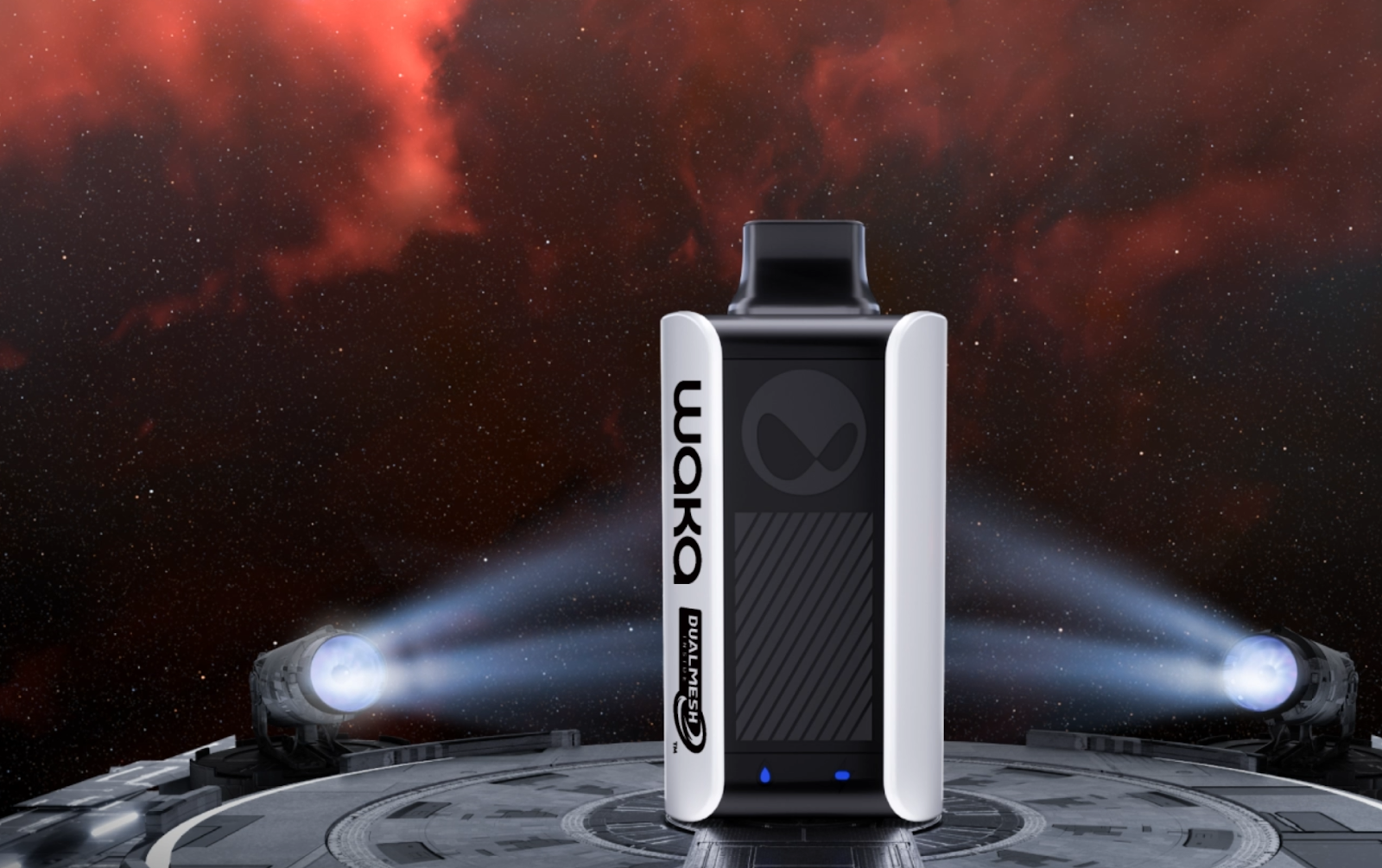
People reach for disposables to keep things simple—but too often the experience isn’t. Flavor can fade or turn harsh before a device is empty, battery and e-liquid levels are a mystery until a dry hit proves the point, and puff counts feel like guesswork that varies by where you live and how you vape. The rise of waka dual mesh speaks to those everyday frustrations: steadier flavor across the fill, clearer status indicators that reduce surprises, and selectable modes make performance predictable…
Dual-Mesh Systems: Context and Overview
Dual-mesh is positioned as more than simply two coils. It pairs a redesigned airflow path with an onboard microcontroller (MCU) to regulate output, plus visible battery and e-liquid indicators that reduce guesswork during late-life draws. Two operating modes—boost (both coils at full power) and regular (MCU-smoothed for consistency)—let users choose between immediate density and steadiness. On paper, certain regional versions pair about 18 mL of e-liquid with an …
Why that matters: The interplay of coil geometry, airflow, and regulated power aims to maintain even heating and lower the chances of an overheated, “dry” draw—especially as a device nears the end of its fill.
Market & technology context for 2025
Dual-mesh coils as a mainstream disposable design
Mesh quickly became standard because it spreads heat across a larger surface, allowing e-liquid to vaporize more evenly. Dual mesh extends that idea: two mesh elements increase contact area and, when paired with good wicking, help each draw feel similar from start to finish.
Where dual mesh disposables fit
In a crowded market of lookalike disposables, their platform focuses on transparent and predictable use. The value proposition isn’t just “bigger clouds”—it’s pairing surface area and airflow with an MCU and clear indicators so users can see what’s happening and tailor the experience with mode switching.
What “Dual Mesh” means (device-level mechanics)
Two mesh coils + airflow path & MCU
Dual mesh increases effective surface area, which can help the coil run at a comfortable heat flux instead of pushing a small patch of metal too hard. The reworked airway feeds those coils while the MCU moderates output so the vape feels familiar, even as the liquid level drops.
Operating modes tied to coil setup
- Boost Mode: both coils fire at full power (listed 2 × 10.8 W) for a warm, dense plume when you want it.
- Regular Mode: the MCU evens things out for steadier warmth and flavor, making it a sensible daily default.
Core specifications relevant to performance & use
- E-liquid volume: 18 mL
- Puff estimate: up to 10,000 (highly usage-dependent)
- Nicotine strength (Canada): 18 mg/mL
- Power spec: 2 × 10.8 W in Boost Mode
- Indicators: lights for battery and e-liquid levels
User-experience features driving adoption
Mode switching & predictable output
A two-mode layout meets two common needs. Some moments call for immediate density and warmth—Boost Mode obliges. The rest of the time, Regular Mode favors consistency. The key is that the device treats output as a controllable variable, not a fixed guess, so flavor drift over a device’s life is less noticeable.
Transparency in use
If you’ve ever nursed a device and wondered whether you had three good draws or just one scorcher left, status lights are a relief. Battery and e-liquid indicators make end-of-life behavior less of a surprise, which in practice helps reduce harsh hits and keeps taste closer to what you expect.
Performance claims vs. single mesh
Vendor-stated advantages
You’ll see claims about larger clouds, fresher taste, and more stable performance. Read them for what they are—manufacturer statements—and evaluate the engineering behind them: surface area, airflow, and regulated output are credible levers for draw quality.
Independent technical context
From a purely engineering perspective, distributing heat across more surface area and regulating power tend to produce a more uniform aerosol. Consistency also depends on wicking and liquid composition, but dual mesh plus power control is a coherent way to achieve steadier results without turning the device into a science project.
Quick comparison: dual mesh vs. single mesh (engineering view)
| Aspect | Dual mesh (two mesh coils) | Single mesh (one mesh coil) |
| Heating surface | Larger combined area for vaporization | Smaller total area |
| Heat distribution | More uniform when properly wicked | More concentrated hotspots |
| Power management | Often paired with MCU & multi-mode | Typically, one output profile |
| Flavor consistency | Designed to be steadier draw-to-draw | More prone to drift as wicking ages |
| End-of-life predictability | Status lights + regulation reduce surprises | Users feel alone |
Why dual mesh is gaining preference in 2025
High-capacity synergy
Capacity and control go hand in hand. With 18 mL on board, keeping the last quarter of the fill tasting like the first matters. Dual mesh helps maintain vaporization efficiency, while the MCU and mode options keep output in a comfortable range as conditions change.
User transparency
Clear indicators mean fewer mysteries. When you can see battery and e-liquid status, you’re less likely to bump into a dry, overheated draw—and more likely to plan a charge or a replacement before you need one.
Platform branding
DualMesh works as a platform concept: coils, airflow, power control, and indicators. It’s a holistic approach built to make the experience predictable, not just powerful. That predictability is the story many users want in 2025.
Considerations & variability
Nicotine strength varies by region.
Even when a model name is the same, what’s available in your country can differ. Check labels and local rules to ensure you know exactly what you’re buying and how it’s intended to be used.
Puff count & “2×” claims
Treat puff numbers as ceiling estimates. Your draw length, the time between puffs, ambient temperature, and mode selection all influence the final tally. What matters more is whether the last 20% of the device feels like the first 20%. That’s where dual mesh and regulated output tend to show their value.
If you’re evaluating a dual-mesh disposable with two selectable modes, visible battery and e-liquid indicators, and MCU-regulated output, this device fits that brief.
Conclusion
Disposable vapes are designed to be easy to use. In 2025, the better ones are also consistent and transparent. Modern dual-mesh disposables bring those qualities together: spread the heat, regulate the power, show the user what’s left, and make the last draw feel like the first. If you’re choosing your next disposable, look for a balance of capacity, control, and clarity—features that make everyday use simpler and more reliable.




Leave a Reply