A diamond blade has no cutting edge at all
Run a finger along a new diamond blade and there is nothing sharp to feel. The rim is a band of metal segments with industrial diamonds scattered through them, and those exposed crystals scratch away the stone and cement a tiny amount at a time. A concrete saw is really a grinder turned on its edge, and that changes how it should be used, especially in the Canadian fall when crews hurry to finish driveways and patios before freeze-up.
The metal has to wear so the diamonds can work
Each diamond does its work until it cracks or pulls loose. For the blade to keep cutting, the metal bond holding the diamonds must wear away at about the same rate, exposing fresh crystals underneath.
If the bond is too hard for the material, the worn diamonds stay locked in place and the blade glazes. It stops cutting, heats up, and the operator pushes harder, which only makes it hotter. If the bond is too soft, diamonds fall out before they are worn and the blade disappears quickly.
Why does harder concrete need a softer blade?
Hard, cured concrete with dense aggregate wears diamonds quickly but barely touches the bond, so a softer bond is needed to release worn crystals in time. Soft, abrasive material does the opposite, eating the bond fast, so it calls for a harder one.
- Cured concrete, hard aggregate: softer bond keeps diamonds fresh
- Green concrete or asphalt: harder bond resists abrasion
- Heavy reinforcing steel: blade rated for rebar cutting
- Brick and block: general-purpose bond usually suits
Matching the concrete saw blade to the material matters more than engine power. A glazed blade on a strong saw cuts slower than a correct blade on a modest one, and a glazed rim can often be reopened by a few short cuts into an abrasive block.
How a walk behind concrete saw takes its depth in steps
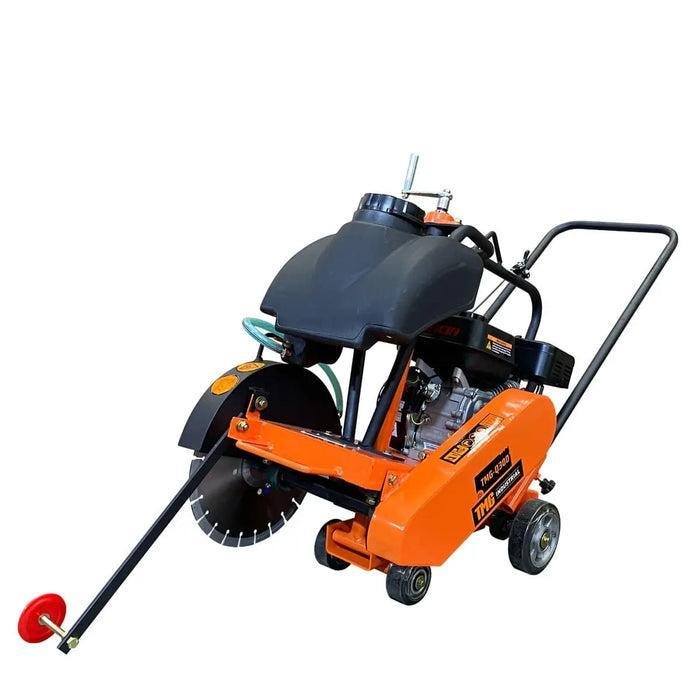
The saw lowers its spinning blade into the slab and is pushed slowly along a chalk line. Taking the full depth at once overloads the blade and bends it off line. Cutting in shallow passes keeps it straight and cool.
The blade should never be twisted or steered sideways once it is in the slab. A cut that starts to pinch, because the slab has shifted or the line has wandered, can bind the blade and throw the saw back toward the operator. Lifting out, correcting the line and lowering again is always safer.
Timing matters on a fresh pour. Control joints are cut once the surface can bear the saw without raveling, but before shrinkage cracks form on their own. Miss that window and the slab chooses where it cracks.
Water does two jobs
Water flowing over the blade keeps the segments cool, and it also traps the fine dust that dry cutting throws into the air. That dust contains crystalline silica, which Canadian workplace rules treat as a serious lung hazard, and wet cutting is one of the main ways to control it.
The slurry that results needs handling too. Cement washings are strongly alkaline, so they should be collected and left to settle rather than rinsed into a storm drain, a detail easily forgotten when finishing a driveway at the end of a long day.
For one-off jobs a concrete saw rental is often sensible. The TMG Industrial walk-behind model runs on a 6.5 horsepower Loncin engine, a size that suits slab and joint cutting better than it suits deep structural work.




Leave a Reply