Introduction
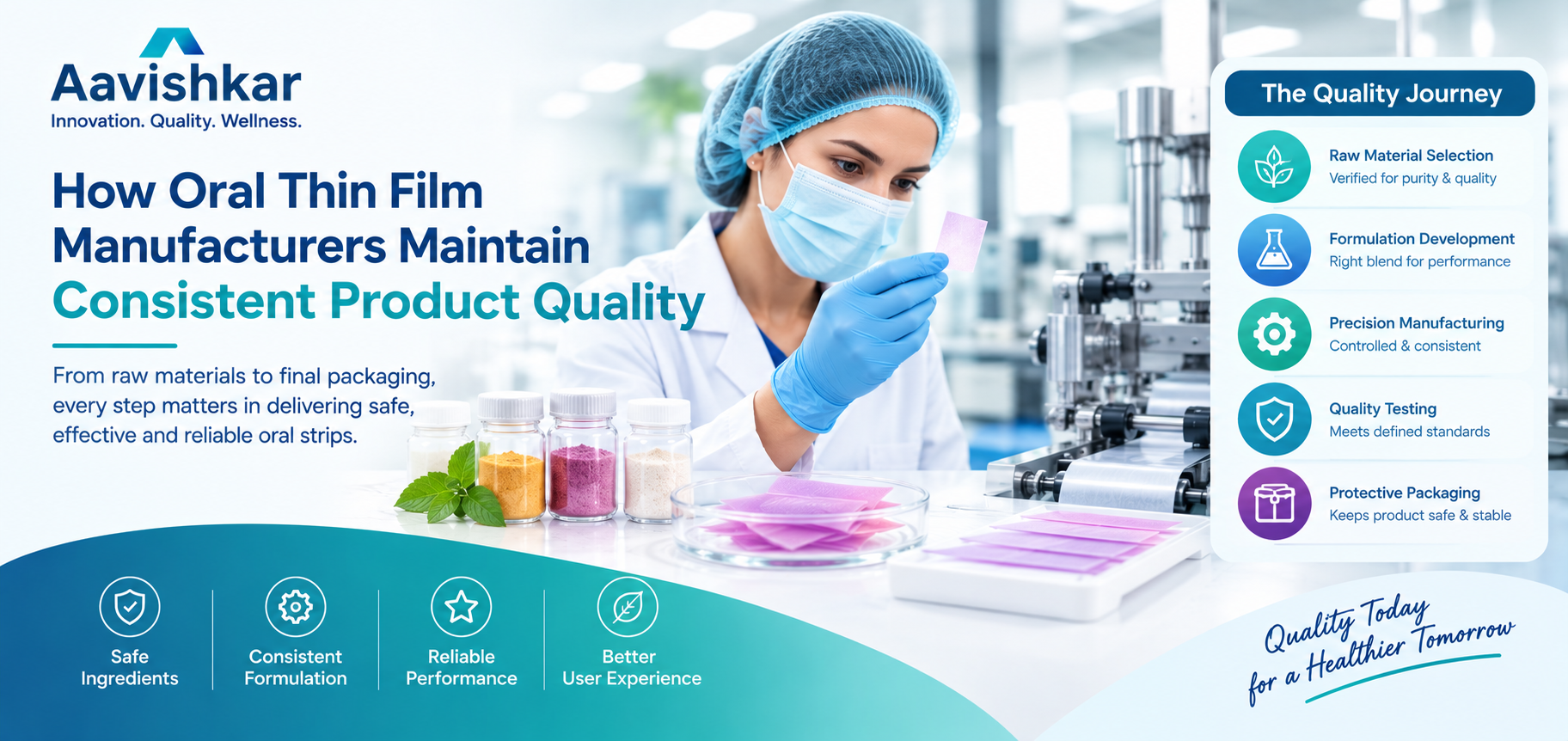
Product quality is a major consideration in the nutraceutical industry, where consumers and brands expect supplements to meet clearly defined standards. As oral dissolving films gain attention as an alternative delivery format, manufacturers must ensure that each batch meets the intended specifications for composition, physical characteristics, stability, and packaging.
Producing a consistent oral thin film requires careful planning and control throughout the manufacturing process. The quality of the finished strip depends on several connected factors, including raw materials, formulation design, ingredient distribution, film processing, environmental conditions, testing, and storage.
Understanding these steps helps supplement brands evaluate potential manufacturing partners and understand how quality is maintained from product development to final packaging.
What Is Oral Thin Film Manufacturing?
Oral thin film manufacturing involves producing thin sheets that contain selected active ingredients within a film-forming formulation. The material is processed into a film, dried or otherwise treated under controlled conditions, and cut into individual strips.
The finished product is intended to dissolve in the mouth according to its design and formulation.
An experienced oral thin film manufacturer must understand the relationship between ingredients, processing conditions, film properties, and packaging requirements. A change in one area can affect other characteristics of the product.
For example, ingredient concentration may influence taste and film flexibility, while environmental humidity may affect the film’s moisture content and physical behavior.
1. Selecting and Verifying Raw Materials
Quality control begins with the materials used in the formulation.
Manufacturers need defined specifications for active ingredients, film-forming materials, flavors, sweeteners, and other formulation components. Depending on the product, material checks may include identity, purity, quality documentation, and other relevant attributes.
Proper storage and handling are equally important. Some ingredients may be sensitive to heat, light, or moisture, so storage conditions should reflect their characteristics.
Material traceability also helps manufacturers identify which ingredients were used in a particular batch. This information supports investigations if a quality concern arises later.
2. Developing a Suitable Formulation
Formulation development is one of the most important stages in oral film production.
The selected ingredients must work within a film-forming system while meeting the intended product requirements. A formulation needs to be suitable for processing and should produce a film with appropriate physical and sensory characteristics.
During development, specialists may assess:
- Ingredient compatibility
- Active ingredient concentration
- Film flexibility and strength
- Taste and aftertaste
- Moisture behavior
- Dissolution characteristics
- Stability during storage
Not every ingredient can be incorporated into an oral film at every concentration. A formulation must therefore be evaluated for feasibility before moving to larger-scale production.
3. Maintaining Uniform Ingredient Distribution
Each strip should meet the product’s defined requirements for ingredient content.
Uniform distribution can be challenging when a formulation contains multiple active ingredients or materials with different physical properties. Mixing procedures, ingredient characteristics, and processing conditions can influence how evenly the components are distributed.
Manufacturers establish appropriate procedures and use relevant testing methods to evaluate consistency.
Depending on the formulation and applicable requirements, testing may assess active ingredient content, uniformity, weight variation, or other indicators.
The purpose is to confirm that the product meets its established specifications rather than relying on visual appearance alone.
4. Controlling Film Thickness and Dimensions
The dimensions of an oral strip can influence its physical characteristics and consumer experience.
Manufacturers may monitor thickness, length, width, weight, appearance, and other relevant properties. These measurements help identify variation during production.
If film thickness varies considerably, it may affect drying, handling, flexibility, or dissolution behavior. Cutting accuracy also matters because each finished strip must have the intended size and appearance.
Defined process parameters and suitable equipment help manufacturers control these characteristics across production runs.
5. Managing Drying and Environmental Conditions
Film processing requires appropriate control of conditions such as temperature, airflow, and humidity, depending on the manufacturing method.
Drying that is too rapid or insufficient may influence the film’s texture, flexibility, moisture level, or uniformity. The suitable conditions depend on the formulation and equipment being used.
Environmental monitoring can help manufacturers identify conditions that may affect production quality.
Humidity is particularly important because some oral films are sensitive to moisture. Maintaining suitable conditions during processing, storage, and handling helps reduce the risk of unwanted changes.
6. Evaluating Physical Strength and Handling
Oral strips need to be thin enough for their intended use while remaining practical to handle and package.
If a film is too brittle, it may crack or break during cutting or handling. If it is too soft or sticky, it may create difficulties during production or packaging.
Manufacturers may evaluate properties such as flexibility, tensile strength, folding behavior, and surface characteristics where appropriate.
These tests help determine whether the film can withstand normal manufacturing and handling operations.
7. Checking Dissolution Characteristics
Dissolution is a defining feature of oral films, so manufacturers need to understand how the finished product behaves under specified conditions.
Testing methods should be appropriate to the product and its intended performance requirements.
Dissolution behavior can be influenced by film composition, thickness, ingredient concentration, and processing conditions. Manufacturers therefore evaluate the actual formulation rather than assuming all oral films behave identically.
It is also important to distinguish dissolution testing from evidence of nutrient absorption or clinical effectiveness. A film’s ability to dissolve does not, by itself, establish that an ingredient is absorbed more quickly or produces better health outcomes.
8. Conducting Stability Studies
A product that meets specifications immediately after manufacturing must also remain suitable throughout its intended shelf life.
Stability studies help evaluate how the product changes under defined storage conditions over time. Depending on the formulation, these studies may assess appearance, moisture, active ingredient content, film characteristics, and packaging performance.
The findings can help establish suitable storage conditions and support the proposed shelf life.
Stability requirements differ between products, so testing should be planned according to the formulation, packaging, intended market, and relevant regulatory expectations.
9. Protecting the Product Through Packaging
Packaging plays an essential role in maintaining oral film quality.
Some films can absorb moisture or be affected by environmental exposure. Protective packaging can help maintain the product’s characteristics during transportation and storage.
Manufacturers may assess packaging materials, sealing quality, and package integrity. Individual sachets or other suitable formats can also protect each serving until it is opened.
Packaging decisions should balance product protection, ease of use, portability, and applicable labeling requirements.
10. Maintaining Documentation and Traceability
Quality management depends on accurate records as well as physical testing.
Manufacturing documentation can include raw material records, batch details, equipment information, process parameters, test results, packaging records, and deviations from established procedures.
These records help manufacturers trace the production history of a batch and investigate problems when necessary.
A structured quality system also supports staff training, equipment maintenance, change control, corrective actions, and ongoing process improvement.
The Role of Specialized Manufacturing Technology
Oral film production requires equipment and expertise suited to film formulation and processing. Specialized technology can support the development of different formulations, but equipment alone does not guarantee quality. It must be combined with appropriate procedures, trained personnel, suitable testing, and effective documentation.
Aavishkar Oral Strips Pvt Ltd focuses on oral dissolving film manufacturing and private-label product development through its ThinSol™ technology. For brands exploring this category, a manufacturing partner’s technical capabilities and quality processes are important factors to review.
Brands should ask potential suppliers about formulation development, testing methods, stability evaluation, packaging options, production capacity, and the quality documentation available for their products.
Conclusion
Consistent oral film quality is achieved through a coordinated process rather than a single final inspection. Raw material verification, formulation development, ingredient uniformity, film processing, environmental control, testing, stability studies, packaging, and documentation all contribute to the finished product.
For nutraceutical companies, understanding these steps makes it easier to evaluate an oral dissolving film manufacturer and plan a product that meets its intended specifications.
A strong quality approach helps manufacturers identify problems early, maintain batch consistency, and support reliable product development as oral thin film applications continue to evolve.




Leave a Reply