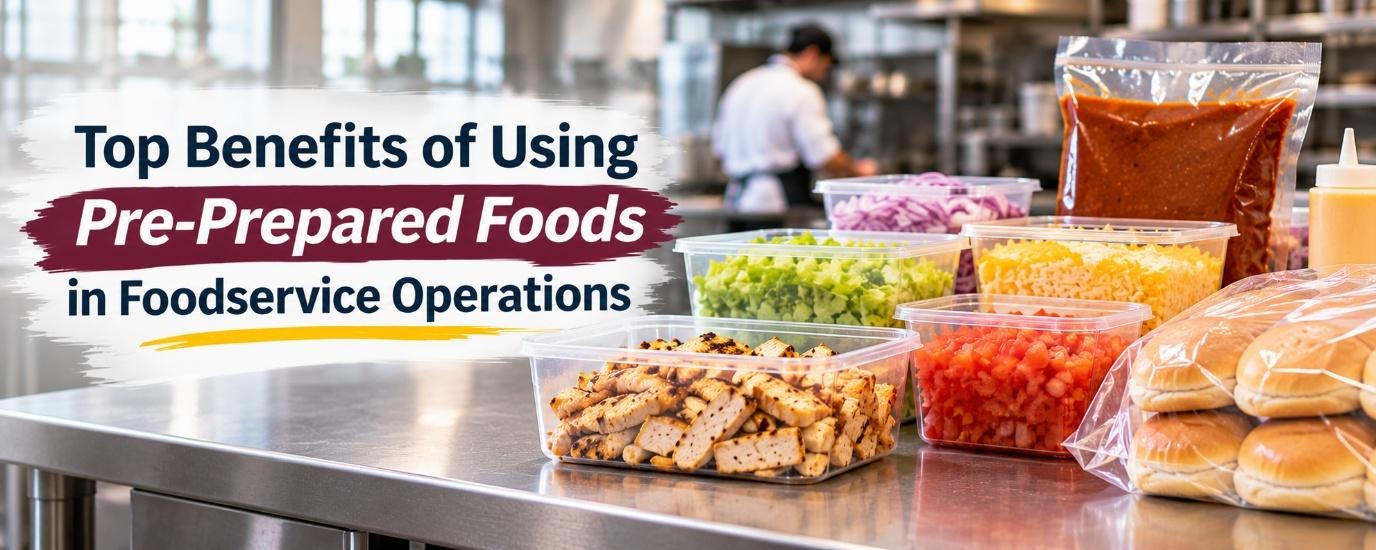
Every minute in a commercial kitchen has a cost.
Vegetables need washing and cutting. Sauces need mixing. Proteins require trimming, portioning and cooking. Desserts need preparation. Ingredients need measuring. At the same time, orders continue arriving and customers expect consistent food without long waits.
For Canadian restaurants and other foodservice businesses facing labour and food-cost pressures, deciding what should be prepared from scratch and what can be purchased pre-prepared has become an important operational decision.
Pre-prepared foods can include everything from pre-cut vegetables and prepared sauces to frozen appetizers, portioned proteins, par-baked bread and fully cooked ingredients.
Used strategically, these products can help reduce preparation requirements, improve consistency, control portions and simplify kitchen operations.
But pre-prepared does not automatically mean less expensive.
The right question is:
Does this product reduce the total cost and complexity of serving the dish?
Here are some of the most important benefits foodservice operators should consider.
What Are Pre-Prepared Foods?
Pre-prepared food is a broad category.
Depending on the product, some or most of the preparation has already been completed before it reaches the commercial kitchen.
Examples can include:
- Pre-cut vegetables
- Peeled and chopped produce
- Pre-portioned proteins
- Fully cooked meats
- Frozen appetizers
- Prepared soups
- Ready-made sauces
- Salad dressings
- Prepared dough
- Par-baked breads
- Frozen baked goods
- Prepared desserts
- Cooked grains
- Prepared side dishes
- Ready-to-use fillings
- Ready-to-serve foods
Some products only remove one preparation step.
Others may simply need heating, finishing or plating.
This gives operators considerable flexibility in deciding where pre-prepared products make sense.
Why Are Pre-Prepared Foods Relevant to Canadian Foodservice?
Canadian restaurants continue to face considerable operating-cost pressure.
Restaurants Canada reported in February 2026 that 89% of operators identified labour costs as a top concern, while 88% identified food costs.
As of November 2025, 44% of restaurants were operating at a loss or breaking even.
Staffing remains another consideration.
Agriculture and Agri-Food Canada reports that Canada’s food services and drinking places had a 4.5% job-vacancy rate in 2025, compared with 2.9% across the Canadian economy.
For full-service restaurants specifically, the vacancy rate was 4.6%.
In this environment, ingredients that can reduce repetitive preparation may deserve a closer look.
1. Reduce Kitchen Preparation Time
The most obvious benefit of pre-prepared foods is time.
Consider how many steps are involved in preparing vegetables from scratch:
- Receive.
- Store.
- Wash.
- Peel.
- Trim.
- Cut.
- Portion.
- Clean the workstation.
- Dispose of trim.
A ready-to-use vegetable may eliminate several of those steps.
The same principle can apply to sauces, proteins, baked goods, soups and desserts.
Gordon Food Service Canada identifies pre-cooked proteins, pre-cut vegetables, and prepared sauces and dressings among the products restaurants can use to reduce labour requirements.
The time saved can then be redirected toward work where culinary staff add greater value.
That might mean finishing dishes, managing service, improving presentation or preparing signature menu components.
2. Help Kitchens Manage Labour Pressure
Pre-prepared food should not necessarily be viewed as a replacement for skilled kitchen employees.
A better use is to allocate skilled labour more effectively.
Imagine a chef spending significant time every morning peeling and chopping a basic vegetable garnish.
Could that employee’s time create more value somewhere else?
Perhaps.
Pre-prepared ingredients can take repetitive, predictable work out of the kitchen while allowing cooks to focus on:
- Cooking
- Seasoning
- Finishing
- Presentation
- Quality control
- Signature recipes
- Customer orders
This can be particularly valuable during busy service periods or when staffing levels are tight.
3. Improve Menu Consistency
Customers expect the same dish every time they order it.
Consistency becomes difficult when preparation varies from employee to employee.
One cook may cut vegetables larger.
Another may portion more protein.
One batch of sauce may be thicker than another.
Pre-portioned and standardized foodservice products can help reduce some of that variability.
For multi-location restaurants, institutional foodservice, hotels and high-volume kitchens, consistency can be especially important.
Standardized ingredients can help create a more predictable customer experience across shifts and locations.
4. Improve Portion Control
Small portion differences can become expensive at scale.
Suppose a restaurant’s standard protein portion is 170 grams.
If employees regularly serve 190 grams, the difference may appear insignificant on a single plate.
Across thousands of orders, it adds up.
Pre-portioned products can make food-cost calculations more predictable.
Operators know approximately how many servings they receive from each case and what each serving costs.
This can support:
- Recipe costing
- Menu pricing
- Inventory forecasting
- Purchasing
- Food-cost control
Consistency does not mean giving customers less.
It means serving the portion the restaurant designed, costed and promised.
5. Potentially Reduce Preparation Waste
Scratch preparation often creates trim.
Vegetable peels, stems, bones, fat and other unused portions can affect the true cost of an ingredient.
Consider two products:
Product A: lower purchase price but requires substantial trimming.
Product B: higher purchase price but arrives ready to use.
Looking only at the purchase price may make Product A appear cheaper.
Looking at the usable yield may tell a different story.
Operators should calculate:
Purchase Cost ÷ Usable Quantity = True Usable Cost
This is one reason pre-prepared ingredients sometimes make financial sense even when the case price is higher.
6. Support Food Waste Reduction
Food waste has a direct financial impact.
The Government of Canada identifies several causes of pre-consumer food loss in restaurants and other foodservice operations, including:
- Food prepared but not served
- Surplus ingredient inventory
- Inadequate storage
Government research also indicates that significant proportions of food purchased by foodservice establishments can become waste.
Pre-prepared foods will not automatically solve this problem.
However, appropriate portion sizes, predictable yields and products that can be prepared according to demand may help operators better match production to sales.
Frozen products can be particularly useful when individual portions can be removed as needed while the remaining inventory stays properly frozen.
The important factor is demand forecasting.
7. Make Food Costs More Predictable
Scratch ingredients can have variable yields.
One case of fresh produce may require more trimming than another.
Cuts of meat can vary.
Employee preparation techniques can also affect yield.
Pre-portioned or ready-to-use products can provide more predictable usable quantities.
For example, if a case contains 50 standardized portions, operators can calculate the direct product cost of each serving relatively easily.
Predictability can support more accurate restaurant menu pricing and inventory planning.
8. Speed Up Service
Preparation efficiency can also affect customer experience.
If ingredients are washed, cut, portioned or cooked before service begins, the kitchen may be able to complete orders more quickly.
This can be valuable for:
- Quick-service restaurants
- Cafeterias
- Catering
- Healthcare foodservice
- Schools
- Hotels
- High-volume restaurants
- Takeout
- Delivery
Speed should never come at the expense of food safety or quality.
But removing unnecessary preparation steps can help kitchens manage peak periods more effectively.
9. Simplify Training
Employee turnover can create significant training requirements.
A complex scratch recipe might require an employee to learn:
- Ingredient measurements
- Knife skills
- Cooking technique
- Timing
- Portioning
- Storage
- Presentation
A prepared component may reduce some of those variables.
This can make certain menu items easier to execute consistently while new employees develop their skills.
Again, this does not eliminate the need for trained staff.
Employees still need appropriate food-safety knowledge, equipment training and an understanding of the restaurant’s standards.
10. Help Manage High-Volume Menu Items
Some products sell so frequently that preparing every component from scratch can put unnecessary pressure on the kitchen.
Think about:
- French fries
- Chicken tenders
- Soup
- Sauces
- Burger patties
- Appetizers
- Bread
- Desserts
If hundreds of portions are served every week, a standardized commercial product may improve production efficiency.
Operators can then reserve scratch preparation for items where it creates meaningful differentiation.
That distinction is important.
Customers may value a restaurant’s house-made signature sauce.
They may care much less whether the potatoes for a side dish were peeled by an employee that morning.
Invest labour where customers notice it.
11. Expand the Menu Without Expanding Prep Dramatically
Adding menu items often adds kitchen complexity.
A new dish might require:
- New ingredients
- Additional preparation
- More equipment
- Extra storage
- Additional training
Pre-prepared components can sometimes allow restaurants to expand menu variety without creating the same level of preparation.
For example, one prepared protein might support:
- A sandwich
- A salad
- A wrap
- A grain bowl
A prepared sauce might work across several dishes.
The best products provide flexibility rather than creating another ingredient that serves only one low-volume menu item.
12. Make Seasonal and Limited-Time Offers Easier to Test
Limited-time offers can create excitement, but developing every component from scratch may require considerable labour for something that remains on the menu for only a few weeks.
Prepared components can lower the operational barrier to testing certain concepts.
Restaurants can evaluate:
- Customer demand
- Sales
- Contribution margin
- Kitchen impact
- Repeat orders
If the item succeeds, operators can decide whether to continue using the prepared product or develop a different long-term approach.
This makes menu experimentation less disruptive.
13. Support Multi-Location Consistency
Consistency becomes more challenging as a restaurant business expands.
A recipe that works perfectly when the owner personally oversees one kitchen may become difficult to reproduce across five, 20 or 100 locations.
Standardized foodservice ingredients can help reduce variation.
A centrally specified sauce, protein, bread or dessert may produce a more predictable customer experience.
This is one reason prepared products can be particularly useful for:
- Restaurant groups
- Franchises
- Hotels
- Institutional foodservice
- Catering operations
Standardization can also make purchasing and recipe costing easier to manage centrally.
14. Reduce Dependence on Specialized Equipment
Scratch production sometimes requires equipment that occupies valuable kitchen space.
Depending on the product, prepared foods may reduce the need for:
- Large preparation areas
- Specialized cutting equipment
- Mixing equipment
- Additional cookware
- Extensive baking equipment
This can be useful in small kitchens, kiosks, cafés and foodservice locations with limited back-of-house space.
Before making equipment decisions, operators should consider their entire menu rather than one product.
15. Improve Purchasing Predictability
Standard case packs can simplify ordering.
If a case provides a known number of servings, purchasing teams can connect sales forecasts more directly to order quantities.
For example:
Expected Sales ÷ Portions Per Case = Approximate Case Requirement
Safety stock and expected demand variation should then be considered.
This can make restaurant inventory management more systematic.
It may also make it easier to compare actual usage against theoretical usage.
16. Frozen Prepared Foods Can Extend Operational Flexibility
Frozen food can be particularly useful for restaurants with unpredictable demand.
Depending on the product and manufacturer’s instructions, operators may be able to remove only the quantity required for service.
Examples include:
- Frozen appetizers
- Bakery products
- Desserts
- Vegetables
- Portion-controlled proteins
- Prepared entrées
- Side dishes
This can reduce pressure to sell the entire product immediately.
It can also help operations maintain menu availability during unexpected demand.
However, freezer space has a cost.
Operators should avoid turning frozen storage into a warehouse of slow-moving products.
17. Prepared Foods Can Support Catering
Catering creates a different operational challenge from normal restaurant service.
A large order may require dozens or hundreds of portions at one time.
Pre-prepared ingredients can help operators scale production while maintaining consistency.
Potential applications include:
- Appetizers
- Breads
- Desserts
- Sauces
- Side dishes
- Prepared proteins
- Breakfast pastries
Operators can then focus labour on assembly, finishing, presentation and logistics.
For catering, consistency becomes especially important because one preparation error can affect many guests simultaneously.
18. But Pre-Prepared Foods Are Not Automatically Cheaper
This is one of the most important points.
A ready-to-use ingredient may cost considerably more per kilogram than its raw equivalent.
That does not necessarily make it more expensive overall.
Likewise, it does not automatically make it cheaper.
Compare the total cost.
For a scratch product, consider:
Raw ingredient cost + labour + waste + preparation supplies + storage + equipment use
For a prepared product, consider:
Purchase cost + finishing labour + storage + packaging where applicable
Then compare yield and quality.
A $30 prepared product may be more economical than $20 of raw ingredients if the scratch version requires significant labour and produces considerable waste.
But if the kitchen has available labour, excellent yield and an efficient process, scratch preparation might still win.
Calculate rather than assume.
19. Quality Still Matters
Operational efficiency cannot rescue a poor product.
Before adding a prepared food to the menu, evaluate:
- Taste
- Texture
- Appearance
- Ingredient quality
- Performance during service
- Holding quality
- Customer response
- Consistency
Test the product under real kitchen conditions.
A sauce may taste excellent immediately after heating but deteriorate during holding.
A frozen appetizer may cook beautifully in one piece of equipment and poorly in another.
Operational testing should happen before a full rollout.
20. Prepared Doesn’t Have to Mean Generic
Some chefs worry that prepared products will make the menu taste identical to competitors.
That depends on how they are used.
A prepared ingredient can serve as a base rather than the entire dish.
For example, operators might combine a commercial component with:
- Fresh herbs
- House seasoning
- A signature sauce
- Fresh garnish
- Custom toppings
- Different cooking or finishing methods
The goal is to identify where customization adds value.
Not every component needs to be made from scratch for the finished dish to reflect the restaurant’s identity.
21. Don’t Misrepresent Products as House-Made
Transparency is part of customer trust.
If a dessert is purchased fully prepared from a supplier, describing it as “house-made” would be misleading.
The same applies to breads, sauces and other prepared components.
Restaurants can still communicate appealing and accurate attributes such as flavour, preparation method or key ingredients without implying that something was made from scratch on site.
E-E-A-T is not only relevant to online content.
The same principles of accuracy and trust apply to menus.
22. Food Safety Requirements Still Apply
Convenience does not eliminate food-safety responsibilities.
The Canadian Food Inspection Agency notes that refrigerated, multi-ingredient ready-to-eat foods can still be exposed to contamination during production, handling, packaging and distribution.
Foodservice operators should follow:
- Supplier instructions
- Required storage temperatures
- Thawing instructions
- Cooking and reheating directions
- Holding requirements
- Product date guidance
- Local and provincial food-safety requirements
Staff should also receive appropriate food-handling training.
“Ready to eat” does not mean “impossible to mishandle.”
23. Evaluate Suppliers Carefully
A prepared food becomes part of your restaurant’s customer experience.
Supplier reliability therefore matters.
When evaluating foodservice suppliers, consider:
- Product consistency
- Availability
- Case size
- Delivery reliability
- Ingredient information
- Allergen information
- Preparation instructions
- Storage requirements
- Product yield
- Customer support
A slightly cheaper product may create more problems if availability is inconsistent or quality varies from case to case.
Total value matters more than case price alone.
24. Use a Make-vs-Buy Analysis
One of the most useful exercises for restaurant operators is a make-versus-buy analysis.
Take a product currently prepared from scratch.
Record:
Ingredient cost
Preparation time
Hourly labour cost
Usable yield
Waste
Storage requirements
Equipment requirements
Consistency
Then compare it with an appropriate prepared alternative.
For example:
Scratch Sauce
Ingredients: $18
Labour: $14
Usable yield: 40 portions
Total direct cost: $32
Cost per portion: $0.80
Prepared Sauce
Case cost allocation: $30
Finishing labour: $2
Usable yield: 40 portions
Total direct cost: $32
Cost per portion: $0.80
At first glance, the cost is identical.
But now consider:
Which version tastes better?
Which is more consistent?
Does scratch preparation use labour needed elsewhere?
Does one create more waste?
Does one require more storage?
Does the house-made version differentiate the restaurant?
The decision becomes much more informed.
25. Decide What Deserves to Be Made From Scratch
The goal should not be to replace the entire kitchen with prepared food.
Instead, divide menu components into categories.
High Customer Value
These are items where scratch preparation meaningfully contributes to the restaurant’s identity.
Examples might include:
- Signature sauces
- Specialty desserts
- House-made pasta
- Signature bread
- Unique fillings
Scratch production may make sense.
Low Differentiation, High Labour
These are repetitive tasks customers may not notice.
Examples could include certain chopped vegetables, portioned ingredients or basic commodity components.
Prepared products may deserve consideration.
High Volume
For products sold hundreds of times, standardized prepared options may improve consistency and throughput.
Low Volume
A specialty ingredient requiring substantial preparation but selling only a few portions may be a poor use of labour.
This framework helps operators invest kitchen time where it creates the greatest customer value.
A Pre-Prepared Food Checklist
Before switching from scratch preparation, ask:
Cost: What is the total cost per usable serving?
Labour: How much preparation time will it save?
Yield: How much of the purchased product is actually usable?
Waste: Will it reduce trim, spoilage or overproduction?
Quality: Does it meet our standards?
Consistency: Will customers receive a more predictable product?
Storage: Do we have sufficient refrigerator, freezer or dry-storage capacity?
Speed: Will it improve service?
Flexibility: Can the product work across several menu items?
Supplier: Can we rely on consistent availability?
Food safety: Can we store, prepare and serve it correctly?
Customer value: Will the change affect what customers appreciate about the dish?
If the answers make operational and financial sense, the prepared option may be worth testing.
Work Smarter, Not Simply Faster
Canadian foodservice operators are working in an environment where labour, food costs and profitability remain significant concerns.
Pre-prepared foods cannot solve every one of those challenges.
What they can do is give operators another tool.
The right products can reduce repetitive preparation, standardize portions, improve consistency, simplify training and make high-volume service easier to manage.
They may also help reduce certain forms of kitchen waste when purchasing and production are matched carefully to demand.
But the strongest strategy is rarely all scratch or all prepared.
It is choosing deliberately.
Make the components where culinary skill creates noticeable customer value.
Consider prepared alternatives where repetitive work consumes labour without meaningfully differentiating the menu.
Then measure the results.
Compare total cost, not just purchase price. Track waste. Monitor labour hours. Evaluate customer response. Calculate yield. Review supplier performance.
In a commercial kitchen, efficiency is not about doing less.
It is about using people, ingredients, time and equipment where they create the most value.



Leave a Reply