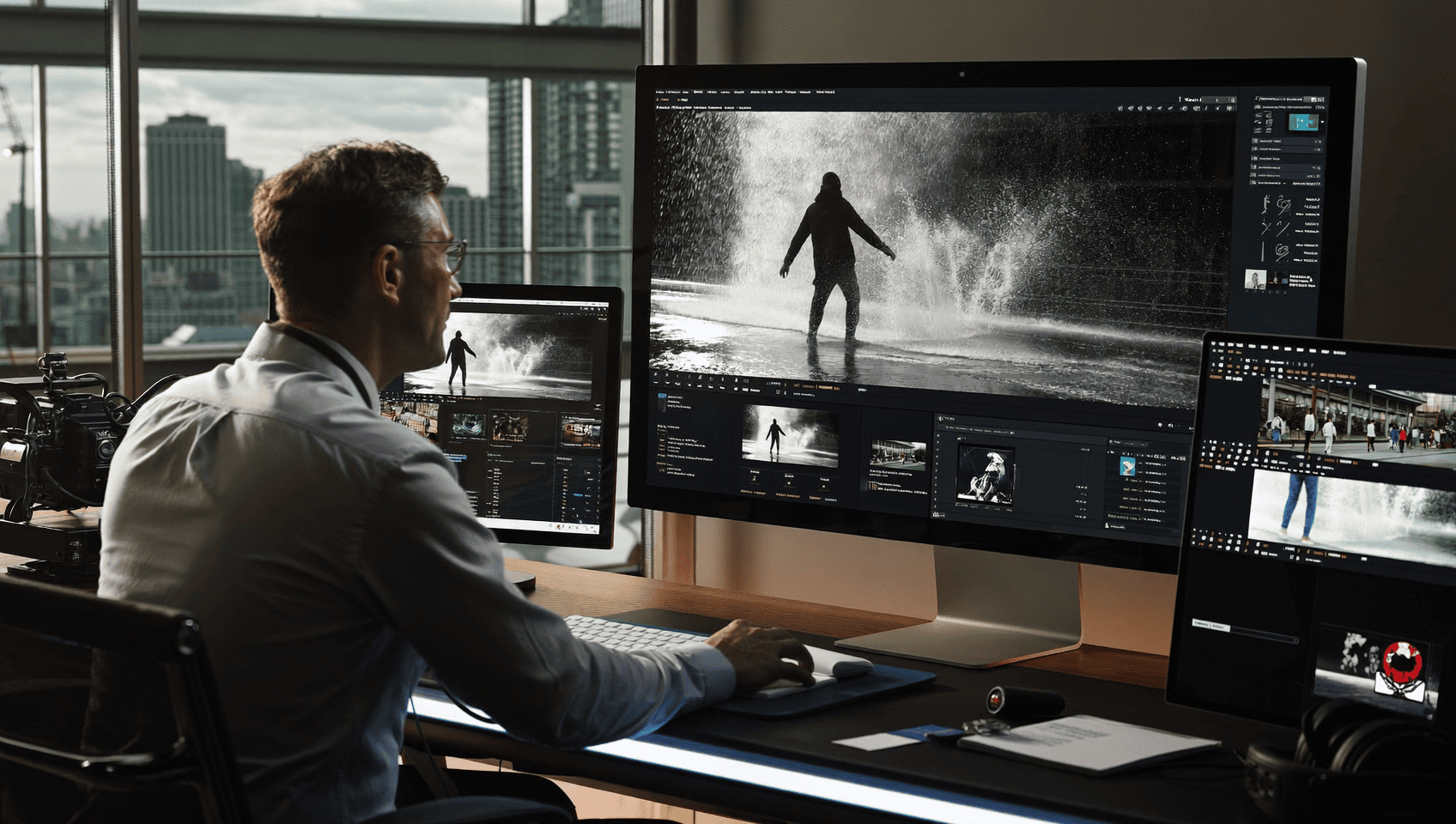
Slowing footage of somebody does not just make it easier to see. It changes what viewers conclude about why they did it.
That finding has been examined most closely in a legal context, where researchers found that people shown an action in slow motion were more likely to judge it deliberate than people shown the same action at normal speed. The extra time on screen reads to a viewer as extra time available to the person acting, and the inference follows automatically.
For anybody producing news video, that is not a stylistic consideration. It means a routine editing decision can shift how an audience judges somebody’s conduct, without a word of commentary changing.
An AI Slow Motion Video Maker makes the technique trivially available, which Higgsfield offers in a browser, and the question of where it belongs becomes more pressing rather than less.
Why Does Slowing Footage Change Judgment?
Because viewers read screen time as deliberation time.
- More frames of an action feel like more time to decide
- Intent appears clearer than the footage supports
- Viewers do not correct for the slowing
- A caption saying slow motion does not undo the effect
- An AI Slow Motion Video Maker pass carries the same weight
The caption point is the one that genuinely surprises people in newsrooms. Telling an audience plainly that footage has been slowed does not restore their original judgment of it, because the inference has already happened before the label registers at all.
That makes labelling necessary and insufficient at once. It is honest, and it does not solve the problem.
The practical conclusion is to leave conduct footage alone rather than to slow it and explain.
Where Does This Matter Most?
Anywhere somebody’s actions are being assessed.
- Incident and crime footage, of any kind
- Police body and dash camera material
- Protest and confrontation video
- Anything connected to a live court matter
- Never run an AI Slow Motion Video Maker over any of it
Local newsrooms handle this material constantly. A confrontation outside a bar, a traffic incident, a scuffle at a meeting. All of it is footage of people whose conduct a community will form a view about.
Court matters deserve particular care from any local outlet. Material relating to an ongoing case can reach prospective jurors indirectly through ordinary local coverage, and slowed footage carries exactly the inference described above into that setting.
Run the footage at speed. If something genuinely happens too fast to see clearly, say exactly that in the reporting rather than slowing it down.
What Should Never Be Presented as Real Time?
Anything that was altered.
- Never run slowed footage without stating it
- Never slow part of a sequence and not the rest
- Never adjust speed to fill a gap in coverage
- Never speed footage up either, which has its own effect
- Never let an AI Slow Motion Video Maker output reach air unlabelled
The partial slowing case is the genuinely subtle one. A sequence running at normal speed, slowing precisely at the moment of an action, then resuming afterwards is making an editorial argument about which moment mattered, without anybody writing a word of commentary.
Speeding footage up has the mirror effect. It makes actions look impulsive, which is an inference too.
Label it on screen rather than only in a voiceover. Clips circulate constantly without their audio attached, and a spoken disclosure does not travel with them.
Where Is It Genuinely Legitimate?
Three places, all uncontroversial.
- Sports highlights, where it is an established convention
- Mechanical explanation, showing how something failed
- Weather and natural phenomena
- Wildlife and animal footage
- An AI Slow Motion Video Maker treatment on any of these
Sports is the clear case. Audiences understand the convention entirely, nobody’s conduct is being judged in a consequential way, and the slowing genuinely reveals something.
Mechanical explanation is comfortably the strongest news use available. Showing how a structure gave way, or how a piece of equipment failed under load, is explanatory rather than inferential, and nobody’s conduct is being judged by it.
Weather footage benefits similarly. Lightning, flooding, snow loading on a roof. All of it is physical and none of it is somebody’s choice.
Do Local Sports Need Any Care?
Some, because the subjects are frequently minors.
- Consent for identifiable footage, per school policy
- Never name a child alongside slowed footage of a mistake
- Avoid dwelling on an individual error
- Follow the school’s policy on filming
- Keep an AI Slow Motion Video Maker clip away from anything embarrassing
The dwelling point matters a great deal more at high school level than it does professionally. A slowed replay of a dropped catch is entirely routine in professional sport and lands very differently indeed on a sixteen year old in a town of thirty thousand people who will all have seen it.
Highlight what went right instead. There is never any shortage of material in a season, and the alternative follows a young person around a small community for years afterwards.
School districts generally already have filming policies in place. Following the existing one is considerably simpler than developing a newsroom position from scratch.
What Does a Small Newsroom Actually Need?
Less of this than it might think.
- Sports highlights, where an AI Slow Motion Video Maker earns its place
- One explanatory piece occasionally
- Almost nothing else
- A clear internal rule about conduct footage
- An AI Slow Motion Video Maker used rarely and deliberately
A rule written down somewhere is worth considerably more than individual judgment exercised under deadline. Something as simple as one line saying conduct footage runs at speed removes that decision entirely from the moment at which it is hardest to make well.
Small teams make these calls quickly, alone, and usually at eleven at night. That is precisely the circumstance in which a standing rule earns its existence.
Review it annually. The tools change faster than the principles do.
Should Viewer-Submitted Footage Be Slowed?
No, and it should be verified first.
- Establish where it came from, before any AI Slow Motion Video Maker is opened
- Ask whether it has been edited already
- Request the original file, not a re-shared copy
- Never slow it before or after broadcast
- Never assume a submitted clip is unaltered
Footage arriving through social channels has frequently been through several hands, and speed changes are among the easiest alterations to make and hardest to detect.
Asking for the original file solves the large majority of it. Somebody unwilling or unable to provide one has told the newsroom something worth noting.
Submitted footage of an incident is exactly the material where slowing causes the problem described at the top of this piece.
Does This Apply to Social Clips?
It does, and more sharply, because context travels worse there.
A clip pulled from a longer piece and posted on a social platform arrives without the reporting around it, and whatever speed it runs at is the only information a viewer has.
What that means in practice:
- Assume the clip travels alone, without any caption
- Burn the label into the frame, not into the description
- Never post a slowed excerpt of conduct footage
- Expect reposting by accounts with their own framing
- Keep the AI Slow Motion Video Maker versions out of the social cut entirely
The burned-in label is the only one that survives. Platform captions get stripped the moment somebody screenshots or re-uploads, and a slowed clip circulating without its label is exactly the problem.
Social clips also outlive their news cycle. Something posted during a developing story resurfaces months later, after charges were dropped or a version of events changed, with none of that attached.
Watch what happens to a clip after posting. A newsroom that sees its own footage recirculated with hostile framing learns quickly which material to cut differently.
Keep a record of what was posted and when. Local outlets are asked about their own social output more often than they expect.
What About Archive and Historical Material?
Leave it as it was shot.
- Never slow archive footage of real events
- Never stabilise or smooth historical material
- Note any processing applied for clarity
- Keep the original alongside anything altered
- Never present an AI Slow Motion Video Maker version as archive
Archive material is a record, and a local outlet holding years of footage is holding something a community will rely on later.
Interpolated frames inserted into historical footage are invented frames. They look entirely plausible to anybody watching and they show things that no camera ever recorded.
Where restoration is genuinely needed to make something legible at all, say plainly what was done to it and keep the untouched original.
How Should Sports Be Shot for It?
At a high frame rate, deliberately.
- One hundred and twenty frames or higher, so the AI Slow Motion Video Maker has frames to work with
- Normal speed for everything else, before Higgsfield
- Plenty of light, since high frame rates need it
- Watch for flicker under arena lighting
- A Higgsfield project holding the treatment across a season
Shooting at a high frame rate throughout a whole game fills storage remarkably quickly and is rarely necessary anyway. Picking the moments where something is likely to happen and shooting only those fast is the realistic approach for a small team.
Arena and school gym lighting frequently pulses rather than emitting continuously, which produces visible banding at high frame rates. Testing a venue before the season starts saves an entirely wasted night of filming.
A consistent look maintained across an entire season makes a small operation’s output immediately recognisable, which matters considerably when competing for attention with far larger outlets.
How Should the Material Be Handled?
With the original kept and the processing recorded.
- Keep every original at capture speed, outside the AI Slow Motion Video Maker
- Note what Higgsfield slowed and by how much
- Store the Higgsfield project separately from the rushes
- Label the exported file as slowed
- Retain originals for any material that may be revisited
Higgsfield keeps the production work in one place as part of an AI creative suite, which matters for a team of under ten producing daily video across several platforms.
The file-level label prevents the one mistake that genuinely matters here. A slowed export sitting unmarked in an archive becomes, three or four years later, somebody’s record of what actually happened that day.
A small newsroom’s archive is frequently the most complete local record that exists, and outlets like this one accumulate footage that no larger organisation holds.
What Would a Standing Policy Say?
Four lines, agreed once.
- Conduct footage runs at speed, with no AI Slow Motion Video Maker involved
- Slowing is for sports, mechanics and weather
- Anything slowed is labelled on screen
- Submitted footage is verified before use
- Originals are retained regardless
Those five lines between them cover very nearly every decision anybody on a small team will actually face in a year.
Write the policy down and put it somewhere people will actually see it, rather than relying on everybody independently remembering the reasoning behind it.
Conclusion
The most consequential thing about slow motion is that it works on the viewer rather than on the footage, and it works whether or not anybody intended it to.
An AI Slow Motion Video Maker belongs in the highlight reel and the explainer, and Higgsfield keeps that consistent across a season.
Run, conduct footage at speed, label anything you slow, verify what arrives, and keep every original exactly as it was shot.



Leave a Reply