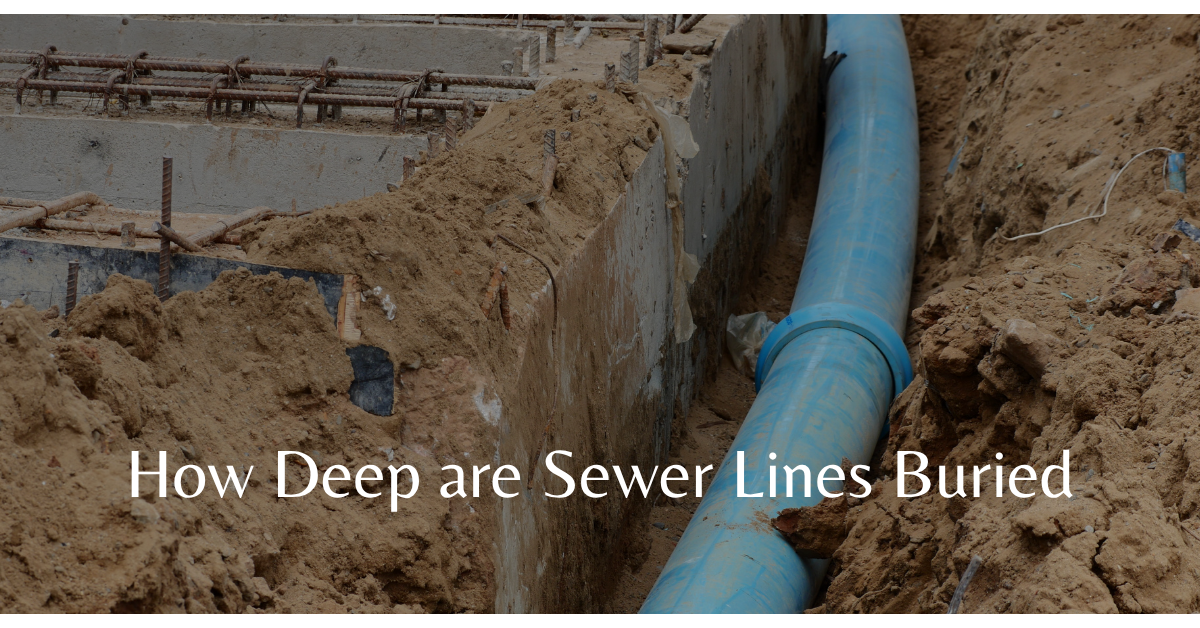
Have you ever questioned yourself what is going on under your feet, under your lawn, driveway, or your neatly paved sidewalk?
The sewer line is one of the most significant components of the plumbing of your home, hidden under the ground. It may be an extension of what you are planning or even the cloggy drainage systems, when the question usually arises; how deep are sewer lines buried? It’s something every homeowner should know, especially if you’ve ever needed sewer line replacement in Toronto or sewer repair in Toronto. It is not an identical response to all, since the length of your sewer line will differ, depending on your location, how old your home is, and what the local building ordinances provide.
Its Foundations: How Deep Are Sewer Lines?
Sewer lines, in most homes, are covered with only 3 to 6 feet of soil, however, this may be different. The number one factor? Climate. In colder areas such as Ontario, the frost line (where ground freezes in winter) is enormous. To avoid freezing and cracking sewer pipes must be below that frost line. Hence, in areas where there are extreme winters, your sewer lines will most likely be at a depth of six feet, or more.
In other areas where there is no or minimal ground freezing like in warmer climates, the lines can be shallower, which saves time and effort when setting them up. Therefore, when a man wonders how deep the sewer lines are buried, the easiest way to answer is; this depends on your local weather, soil, and building codes.
How Far Down Are Sewer Lines?
When you are asking yourself how deep do sewer lines go, consider it as a range and not a number. Homes that are old and particularly those constructed prior to the onset of modern standards in plumbing have shallow lines. Modern constructions, especially those basement-planned, are laid with deeper systems, and may extend 6 to 10 feet down of the soil.
It’s all about gravity. To dispose of waste effectively in sewer systems, there is a slope to move from your home to the main sewer system. It is to say that the farther it is or the more stories in your house, the longer you have to make the line.
Municipal main, by the way, are far deeper, down to the ground, 25 feet at the bottom of the street. That is why when you come upon a large excavation on the road, it is as though they were digging deep to the bottom of the earth!
Why Does Sewer Depth Matter?
Deepness is not only about freezing prevention. It has an impact on the performance of your plumbing itself as well as on the potential cost of repair in the future.
Damage Protection: The deeper lines are less subjected to outside force by the cars, roots and by the moving soil.
Smooth Drainage: A sloping line correctly is sufficient to make everything flow without the use of pumps.
Repair Costs: For the more one digs the farther the pipe, the more expensive it is to repair, as it becomes more difficult to reach and excavate.
This is why such a new technique as trenchless repair has become so popular now. Instead of digging up your entire yard to get professionals to fix or replace the sewer pipes, they do the job without tearing up your entire yard, a complete game changer to homeowners.
Deepness of sewer lines (in Canada in particular)?
In Canada, the majority of the local plumbing codes suggest the installation of sewer lines at least 4 feet deep. The depth assists in preventing freezing and making maintenance feasible. But in very cold localities, or where the frost is deep, pipes may be dug down as much as 6 or 8 feet.
These are naturally not universal figures. The type of soil, the slope and the home design all come in. The point here is that your line must never be above the frost line (the magic depth in which the ground remains thawed even in winter)
So if you’re in Toronto, a typical line depth will likely fall in the 4–6 foot range.
Identifying the Problems Underground
You have no idea what is happening in your sewer line but your house may give you a couple of hints. Watch for these signs:
- Constant low drains or clogs.
- Weak gurgling during urination.
- Wet areas or the greenery in the yard (sewage is like fertilizer, yes).
- Unattractive odors in the ground or the basement.
In case some of that sounds to you, then the time is to call in professionals. They will even be able to check the line with the help of special cameras and correct the problem before it develops into a real catastrophe.
Bringing It All To A Close
So, when all’s said and done, how deep are sewer lines buried? Typically between 3 and 6 feet, depending on your region and home type. In places like Toronto, you can expect them around 4 to 6 feet deep, safely below the frost line.
Remember, though, the depth itself isn’t the only thing that matters, it’s the condition of the pipe. Whether you’re dealing with old clay lines, shifting soil, or root intrusion, getting a professional inspection can save you a lot of headaches (and money) down the line.




Leave a Reply