Enterprise sustainability teams face a critical challenge: turning scattered emissions data, supplier information, and regulatory requirements into auditable, multi-framework reporting outputs.
The complexity only grows as CSRD, SFDR, ISSB, and regional regulations multiply across markets. A robust ESG reporting platform becomes essential, not optional, when you’re managing decarbonisation at scale across global operations.
This guide examines leading ESG reporting and disclosure platforms designed for enterprises with complex reporting structures, stringent audit requirements, and need for actionable intelligence alongside compliance outputs.
1. Persefoni (Now Part of Workiva)

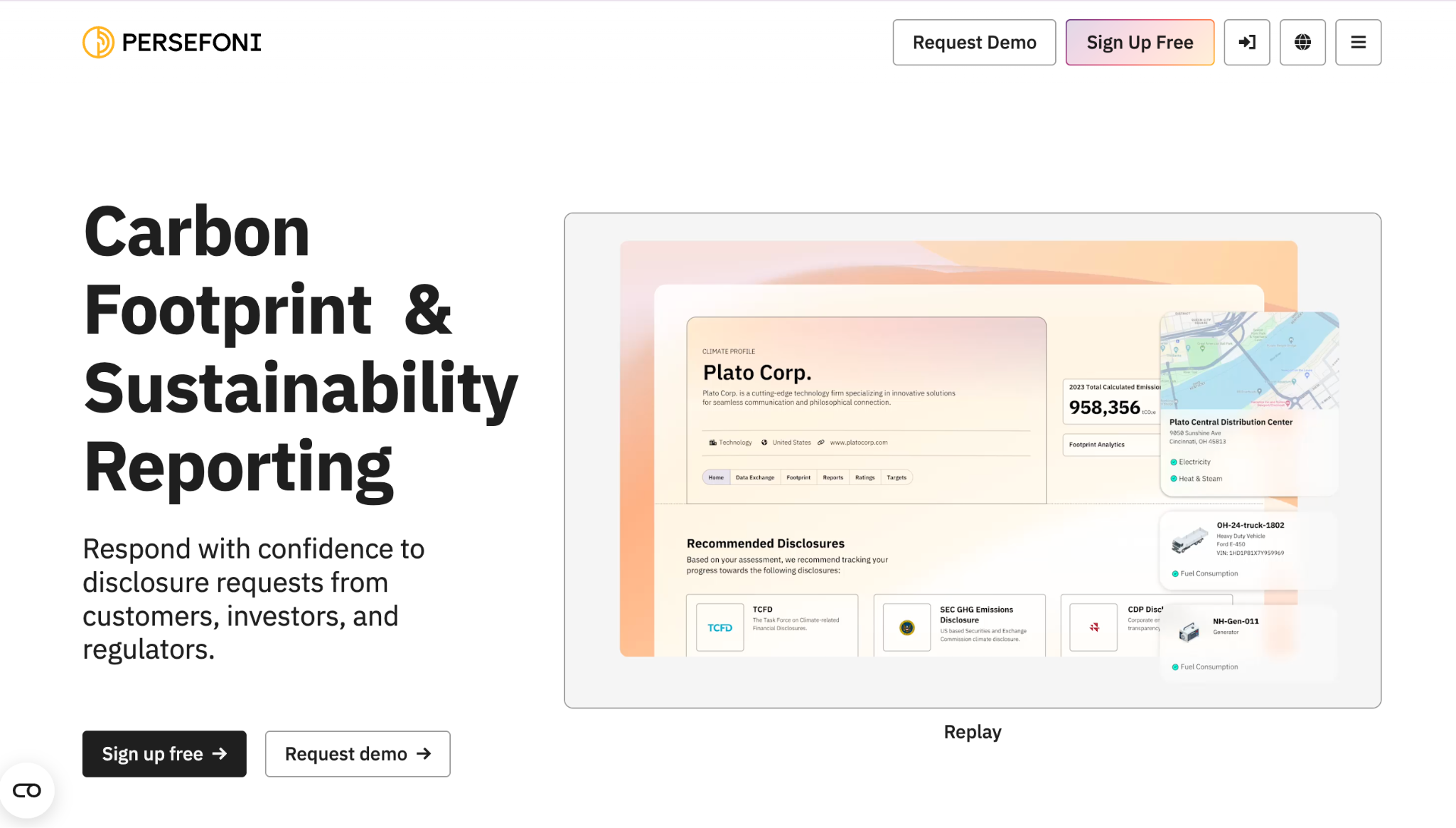
Persefoni built its reputation as a carbon accounting specialist with deep regulatory expertise. The platform consolidates emissions data from multiple sources and automates multi-framework reporting across CSRD, GRI, TCFD, and CDP.
The platform excels at handling scope 1, 2, and 3 emissions calculations with embedded domain logic. Its analytics layer supports scenario modelling for decarbonisation planning, and the system maintains strong audit trails for compliance confidence.
Persefoni’s strength lies in its structured approach to regulatory frameworks and its ability to scale across large, multi-entity corporate groups.
Integration with ERPs and procurement systems is available, though the implementation process typically involves dedicated setup time. The interface supports both technical users and business stakeholders, though many organisations require extended training for full platform leverage.
2. Sweep: Enterprise-Grade Sustainability Intelligence

Sweep stands out as one of the best ESG Reporting and Disclosure platforms by taking a different architectural approach that prioritises flexibility alongside compliance.
The platform centres on the “Sweep Tree” data model, which adapts to any organisational structure, allowing enterprises to reflect actual reporting lines, cost centres, and operational hierarchies without forcing rigid system constraints.
Sweep handles multi-framework reporting natively across CSRD, SFDR, ISSB, TCFD, CDP, GRI, and SB 253/261 from a single trusted dataset.
This means you build your data once and report across frameworks without manual reconciliation. The embedded “Sweepy” AI layer identifies emissions hotspots and supports predictive insights for reduction planning.
Where Sweep differentiates is in operational integration: the platform connects with finance, procurement, ERP, and HRMS systems to embed sustainability data into existing workflows.
Built-in supplier portals accelerate Scope 3 data collection, while role-based access and approval workflows reduce manual coordination bottlenecks. Organisations report a 70 percent reduction in data wrangling time compared to spreadsheet-based processes.
The platform includes audit-ready outputs with embedded regulatory expertise and narrative guidance, so your compliance outputs meet assurance requirements without additional translation layers.
Deployment supports both cloud and hybrid architectures for enterprises with specific security or data residency requirements.
3. Watershed

Watershed positions itself as an “enterprise emissions platform” with emphasis on actionable decarbonisation. The system connects data sources across facilities, supply chain, and financial systems to build a centralised emissions inventory.
The platform offers flexible custom reporting structures and integrates with popular ERPs and data warehousing platforms. Its scenario modelling tool helps teams evaluate reduction pathways and set credible science-based targets.
Watershed’s strength is in making emissions data accessible to non-technical stakeholders through dashboards and visualisation, supporting broader internal engagement beyond compliance teams.
Integration typically requires moderate technical effort. The platform suits organisations with clear data governance and existing data infrastructure.
Reporting outputs support CSRD, CDP, and TCFD, though multi-framework automation is less comprehensive than some competitors.
4. Measurabl

Measurabl emerged from the real estate and facilities sectors, bringing deep expertise in scope 1 and 2 emissions across building portfolios. The platform has expanded to support broader ESG metrics including waste, water, and social indicators.
The system excels at automated utility bill aggregation and anomaly detection, which reduces manual data validation cycles. Measurabl integrates with energy management systems and building control platforms, making it particularly strong for organisations managing large facility networks.
The platform supports CSRD and CDP reporting, though the primary strength remains in operational emissions and facility-level insights. It works well as part of a broader ESG stack for enterprises with significant real estate footprints.
5. Workiva (Wdesk Platform)

Workiva’s Wdesk platform serves as a broader governance and disclosure solution, with ESG reporting as one module within a larger enterprise information management system.
The platform emphasises data integrity, audit trails, and regulatory compliance across financial and sustainability reporting.
Wdesk brings particular strength in organisations already using Workiva for financial consolidation or governance workflows, as sustainability data integrates into existing approval hierarchies and audit controls.
The system supports complex multi-entity structures and meets stringent assurance requirements.
The broader platform scope means more comprehensive governance controls but potentially steeper implementation for organisations implementing ESG reporting only. Reporting supports CSRD, ISSB, and TCFD frameworks.
Key Selection Criteria for Enterprise ESG Reporting Platforms
When evaluating ESG reporting platforms, enterprise sustainability teams should prioritise several factors. The most effective solutions, including best ESG Reporting and Disclosure platforms, combine regulatory expertise with operational flexibility to address the sustainability execution gap.
Data Flexibility and Organisational Alignment. Does the platform adapt to your actual reporting structure, or does it force you to reorganise data to fit the system? Platforms supporting custom hierarchies and multi-entity configurations reduce implementation friction. Strong organisational frameworks like those outlined in PARA method for project management apply equally to sustainability data structuring.
For enterprises building out ESG programs alongside broader business transformation, strategic business coaching can accelerate alignment across finance, operations, and sustainability teams before platform selection.
Multi-Framework Reporting. Single-framework platforms create ongoing reconciliation burden as regulatory requirements multiply. Platforms supporting CSRD, SFDR, ISSB, TCFD, and regional requirements from one dataset simplify compliance cycles. Learn about available ESG reporting tools to compare features.
Audit Readiness. Compliance teams need more than raw data exports. Look for platforms providing audit-ready outputs with narrative guidance, calculation methodologies, and clear data lineage. Real-world enforcement examples, such as environmental compliance actions taken by regulatory bodies, demonstrate the importance of documented reporting and third-party oversight in protecting against costly violations.
Operational Integration. Sustainability reporting isolated in a standalone platform remains a compliance exercise. Integration with finance, procurement, ERP, and HRMS systems embeds sustainability into operational decision-making and accelerates Scope 3 data collection.
Supplier Engagement. Scope 3 emissions collection typically accounts for 70-95 percent of total emissions but remains highly fragmented across supply chains. Native supplier portals and automated data request workflows reduce manual coordination and improve response rates.
Scenario Modelling and Analytics. Beyond compliance outputs, enterprise teams need analytical capability to evaluate reduction pathways, stress-test decarbonisation targets, and support Net Zero planning. Embedded analytics layers save time and improve credibility of reduction strategies.
Implementation and Training Support. Platform strength means little without effective deployment. Evaluate vendor support for data migration, team training, and ongoing platform optimisation.
Conclusion
The ESG reporting and disclosure landscape continues evolving as regulatory frameworks multiply and investor expectations intensify.
For enterprise organisations managing complex reporting structures, fragmented emissions data, and multi-jurisdiction compliance requirements, platform selection directly impacts reporting confidence, compliance outcomes, and operational efficiency.
The most effective platforms combine regulatory expertise with operational flexibility, automate multi-framework reporting from single datasets, and embed sustainability intelligence into broader business workflows rather than isolating it as a standalone compliance function.
Selecting a platform aligned to your actual organisational structure, regulatory footprint, and operational integration needs transforms ESG reporting from a burdensome compliance exercise into a strategic business capability supporting decarbonisation progress and financial resilience.




Leave a Reply