Two places on an expressway generate more specification arguments than a hundred kilometers of open carriageway. One is the toll island, where vehicles must shed speed and thread into a lane. The other is the tunnel portal, where drivers meet an abrupt change in brightness at the moment they most need to see clearly. Add fog or heavy rain and the visual cues thin out further. Lamps for these spots are usually chosen from a short list, and a handful of datasheet lines decide whether the installation is still working in year five.
What an IP code actually promises
Ingress protection ratings come from IEC 60529, and they are worth reading one digit at a time. The first digit covers solids: 5 means dust protected, with limited ingress that must not interfere with operation, while 6 means dust tight. The second digit covers water: 3 means spraying water at up to 60 degrees from vertical, while 5 means jets from a 6.3 mm nozzle from any direction, tested at about 12.5 liters per minute.
So the gap between IP53 and IP65 is real. The first copes with ordinary rain. The second copes far better with road spray, hose-down cleaning and wind-driven water. For a lamp bolted to a toll island, where passing trucks throw water sideways and crews sometimes wash the plaza, that difference tends to show up in service records. Keep in mind that an IP code is a short laboratory test of the enclosure. It says nothing about ultraviolet aging, salt or vibration.
A specification worth reading closely
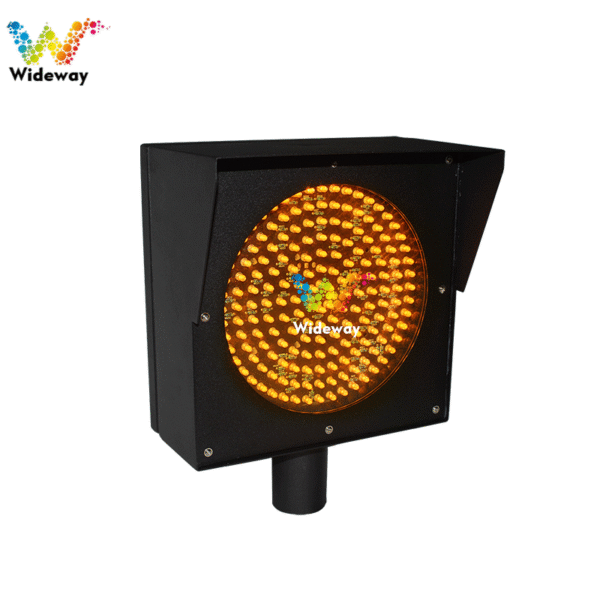
The 200MM square fog light is a useful case study because its datasheet is detailed. Its electrostatically coated sheet-metal enclosure measures 235 × 235 × 120 mm, holds 180 yellow LEDs in the 590 to 595 nm band behind a 200 mm emitting face, and is listed at IP65 with an operating range of -40°C to +80°C and rated power of up to 15 W. The listed visibility distance is at least 300 m. An integrated hood is meant to cut backlight glare in daytime, which matters because sunlight striking a lens can make a lamp hard to read.
Those are the manufacturer’s own figures, and the visibility number in particular is a clear-air rating. In dense fog the practical distance will be shorter, which is exactly why lamps along a corridor are spaced closely rather than relied on one by one. Incheon Bridge in Korea, for example, installs its fog guidance lights at 50 m intervals.
Steady, flashing or synchronized
The lamp supports constant and flashing operation, and it can run alone in flashing mode when no control system exists. GPS-synchronized flashing is offered as a customization. A sensible way to think about the modes, as a design judgment rather than a rule:
| Mode | Where it helps | Trade-off |
| Steady | Marking a fixed edge such as an island nose, where a stable reference is wanted | Draws less attention than flashing |
| Flashing, independent | Isolated hazards and retrofits with no communications | Neighboring lamps drift out of step |
| Flashing, synchronized | Long runs along a ramp or portal approach | Needs GPS timing or a control link |
In principle, GPS gives every lamp the same clock, so they can flash together without a signal cable between them. Timing still needs a rule. In the United States the MUTCD sets beacon flash rates at 50 to 60 per minute, with the lit period taking half to two thirds of each cycle. Other jurisdictions set their own, so confirm the local requirement before configuring a corridor.
The control layer in plain language
Remote switching and adjustable flashing frequency arrive through RS-485 or IoT links. RS-485 is a differential serial bus that supports up to 32 standard unit loads on a cable of roughly 1,200 m (4,000 ft) per segment. A lamp run beside a 3 km tunnel approach therefore needs segments or repeaters, and the designer should count nodes before ordering hardware. Long networks are also prone to grounding and surge trouble, and isolating the nodes is the usual remedy. The datasheet adds lightning and overvoltage protection to the lamp itself, which is the right pairing for equipment standing in the open on a pole.
Mounting and field notes
Installation is pole-mounted. The base lines up with the holes under the luminaire, M12 screws go in with spring washers, and the cable must pass through the pole before the lamp is seated. The vibration of passing trucks loosens poorly tightened hardware over time, so torque checks belong in the maintenance plan. The housing is black, and darker enclosures absorb more heat in direct sun, which is a good reason to look closely at the stated upper temperature limit.
Quick answers
Is IP65 enough for a tunnel portal? For rain, spray and ordinary hosing, yes. For powerful jets, the next step is IP66, which is tested with a 12.5 mm nozzle at about 100 liters per minute. If the portal is cleaned with high-flow equipment, ask for the higher rating.
Does the lamp need a control system? No. It can flash independently. A control system is what adds remote switching, adjustable frequency and fleet-wide coordination.
What should be in the submittal package? Photometric test data, the ingress protection test report, the standard edition referenced, and the communications protocol description. A datasheet table is a claim until a test report backs it.
Toll islands and tunnel portals will always be awkward places to drive in poor weather. The lamps that serve them well are rarely the ones with the longest feature list. They are the ones whose ratings were read carefully, whose control links were planned for the actual cable distance, and whose mounting hardware was checked after the first winter.

Leave a Reply