Disposable cutlery looks like the simplest product in foodservice. A fork, a knife, a spoon, maybe a napkin. Yet the people who make and pack it are dealing with one of the more unsettled product categories in packaging, because the rules on what the cutlery can be made of changed quickly, and they changed differently in different countries.
If you run or plan a packing operation, that unsettled picture matters more than any single speed figure. This article looks at how regulation is reshaping what ends up on the packing line, how big the market really is (the estimates disagree widely), and what a cutlery packaging machine or full line needs to cope with.
Regulation moved the material, not the demand
From 3 July 2021, single-use plastic cutlery, plates, straws, balloon sticks and cotton buds could no longer be placed on the market in EU member states, under the Single-Use Plastics Directive (EU 2019/904). The directive’s list of banned items specifically names forks, knives, spoons and chopsticks. Products already manufactured could still be sold off, and the ban covers sale rather than manufacture, so production for other markets continues.
Other jurisdictions followed their own paths. A BBC report cited in public reference sources notes that a ban on single-use plastic cutlery came into force in England in October 2023, and Canada announced a ban on cutlery and other single-use items in 2020. Market researchers also point to China, India and Japan as countries implementing phase-outs.
The practical result for a packer is a mixed material stream. Wood, bamboo, paper-based and bio-based cutlery sit next to conventional polypropylene and polystyrene. These behave differently on a line. Wooden pieces are stiffer and can splinter or vary in thickness, while thin plastic pieces can flex, nest together or pick up static.
How big is the market? It depends on who you ask
Published estimates of the disposable cutlery market vary roughly eightfold, mostly because analysts define the category differently.
| Source | Estimate |
| Emergen Research | USD 8.50 billion in 2025, 5.8% CAGR to 2035 |
| Expert Market Research | About USD 9.59 billion in 2025 |
| Market Research Future | USD 16.82 billion in 2024 |
| LP Information | USD 2,217 million in 2025 |
| Fortune Business Insights (biodegradable cutlery only) | USD 42.53 million in 2025, 7.76% CAGR to 2034 |
The sensible reading is directional. Nearly every report expects growth in the range of roughly 3 to 8 percent a year, and the biodegradable segment is expected to grow faster from a far smaller base. Treat any single dollar figure with caution, and ask what is counted, whether it includes plates, cups and straws, or just utensils.
What the product looks like when it reaches the pack
Packed cutlery rarely travels loose. Catalogs from foodservice distributors list individually wrapped forks, knives and spoons in cartons of 1,000, plus wrapped kits of fork, knife, teaspoon and napkin, sometimes with salt and pepper, in cartons of 250. A packing system therefore has to handle at least three configurations: single pieces, multi-piece sets, and sets with inserts. Switching between them quickly is a bigger driver of real output than peak speed.
Why inline packing is attractive for molders
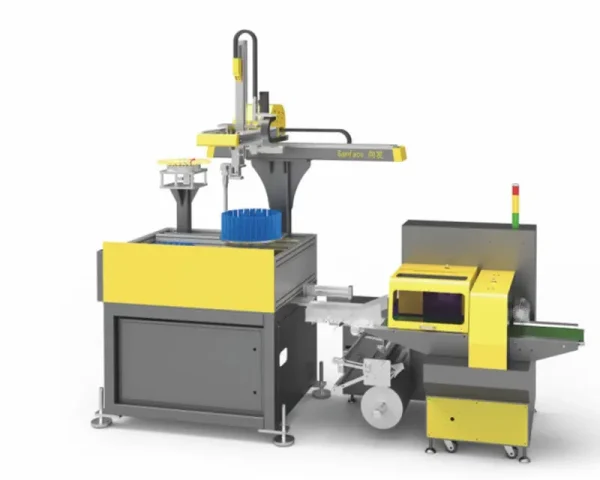
Plants that mold their own cutlery have an option that standalone packers do not: take the pieces straight from the press. One manufacturer describes a system for disposable plastic cutlery that combines a traverse robot, a pickup gripper, a packaging robot and stacked upper and lower plates, with the stated aims of reducing labor cost and making the product more hygienic. The logic is sound in general terms. Every manual touch between mold and bag is a contamination opportunity and a labor cost. The same manufacturer says its machine can package plastic, wooden and biodegradable cutlery.
Reading speed claims carefully
Published figures for wrapping machines range widely. One paper cutlery packer lists 130 sets per minute, a marketplace listing for another machine advertises adjustable speeds of 50 to 200 units per minute, and one supplier’s page cites anything from hundreds to thousands of packs per hour. These are different machines doing different jobs, and none can be compared without knowing the pack format, material and the pieces per pack.
Before trusting a number, ask:
- What was packed during the test, and how many pieces per pack?
- Was the figure measured over an hour or a shift, or only as a peak?
- How long does a changeover take between formats?
- How does the machine react to a misaligned or broken piece?
Short FAQ
Is plastic cutlery packing still a viable business? In many regions yes, because the ban in the EU applies to sales within the bloc, and other markets are at different stages. The sound strategy is to choose equipment that is not locked to one material.
Does automation really help hygiene? Reducing human contact reduces contamination routes, but it does not replace hygiene practices, cleaning schedules or food-contact material compliance for the cutlery itself.
What maintenance should be expected? Typically cleaning, lubrication of moving parts and inspection for wear. Ask for the actual schedule in writing.
The takeaway
Regulation changed the material mix far faster than most equipment cycles. A line that can pack a stiff wooden fork on Monday and a thin plastic spoon on Tuesday, in whatever bag or kit the customer asks for, is worth more than one that wins on a brochure speed.

Leave a Reply