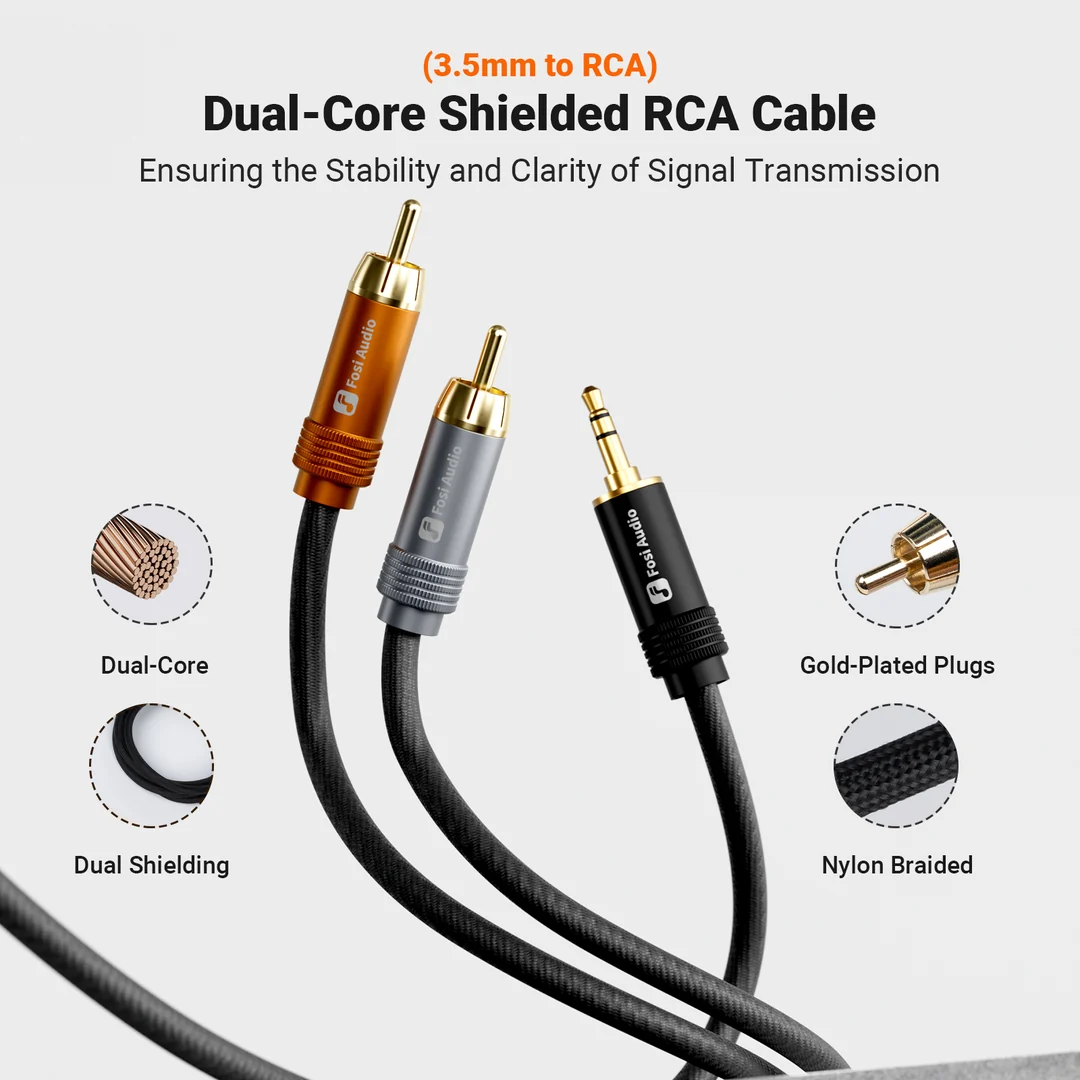
Open a drawer of old cables and you will find a tangle of leads that all end in the same round plug. The plug is called RCA, after the company that developed it, and it has outlived most of the equipment it was designed for. The shape is the same on a stereo lead, a video lead, a subwoofer cable and a digital coaxial lead. The signals they carry are not. That is where most of the confusion, and a fair amount of unnecessary spending, comes from.
A connector is a shape, not a standard
The RCA plug tells you how a cable fits, not what travels through it. Common colour coding gives a hint: red and white for the right and left channels of a stereo pair, yellow for composite video, and orange on many devices for digital coaxial. Treat colours as a guide only. They are conventions printed on a plastic collar, and nothing stops a manufacturer, or a previous owner, from mixing them.
What matters is the signal, and there are really three families.
| Signal | What it is | Typical label |
| Analog stereo | Two unbalanced line level signals | Audio In or Out, red and white |
| Composite video | One video signal on a single coaxial lead | Video, yellow |
| Digital coaxial (S/PDIF) | Encoded digital data on electrical coax | Coaxial, Digital Audio |
Plug a digital coaxial output into an analog input and you will not get normal sound, because the analog input cannot decode the data stream. Plug a video lead into an audio input and the result is noise or nothing. The plugs fit every time, which is exactly why the mistake is so easy to make.
Line level, in numbers
Consumer equipment with RCA jacks usually works at a nominal line level of minus 10 dBV, equal to about 0.316 volts RMS. Professional equipment typically uses plus 4 dBu, which is about 1.228 volts RMS, and the gap between the two works out to roughly 11.8 dB. The consumer convention was introduced originally to keep equipment cheaper to build. Two details are worth knowing. Line outputs generally present a source impedance somewhere between 100 and 600 ohms. And the connector type does not tell you the level, so an RCA jack on one device may not sit at the same voltage as an RCA jack on another. If a signal arrives far too loud or too quiet, check the level setting before blaming the cable.
The 75 ohm question
Composite video, digital coaxial and many subwoofer leads are all built on the same idea: a single 75 ohm coaxial cable. Component video uses three of them, and S-Video uses two bundled together. That is why a video lead will often work as a digital coax lead or a subwoofer lead in a pinch.
Impedance matters most for digital coaxial, because the connection is designed around 75 ohms, and a mismatch can cause reflections that damage the data signal over longer runs. A general purpose analog RCA lead may or may not be 75 ohms. Many manufacturers now use 75 ohm cable for all their RCA interconnects simply because stocking two types of coax makes no commercial sense. Experienced installers say that in short runs an ordinary RCA lead often works fine for a digital connection, but they still recommend proper 75 ohm cable where it is available.
For plain analog stereo, impedance matters much less, since the signal frequencies are low and the lengths are short. The things that matter there are shielding, plug quality and sensible length.
Which swaps are safe
| Swap | Verdict | Reason |
| Video lead used as subwoofer lead | Fine | Both are single 75 ohm coax |
| Video lead used as digital coax | Good | Same construction |
| Analog stereo lead used as digital coax | Often works, not ideal | Impedance may not be 75 ohms |
| Digital coax lead used as analog stereo | Works electrically | Use two, one per channel |
| Any RCA lead into the wrong type of jack | Will not work properly | Different signal types |
Choosing a lead for each job
- Analog stereo: pick a well shielded lead with firm plugs, sized to the run. This is the place where ordinary rca cables with a full length shield and snug connectors serve you best, and it is rarely worth paying for anything more exotic.
- Subwoofer: a single lead, usually longer than the others. Shielding matters because the run often crosses a room and passes mains cables.
- Digital coax: a true 75 ohm lead, ideally short and unkinked.
- Video: a 75 ohm lead, because impedance errors show as ghosting or softness.
FAQ
Does gold plating improve the connection? It resists corrosion, which helps over time, but it does not change how the cable behaves electrically.
Can I use a stereo RCA cable for a subwoofer? Yes. A subwoofer lead is essentially an analog line level lead, and one cable carries the signal.
Are digital coaxial and RCA cables the same thing? They share the connector. The cable construction and the signal inside are different, and the receiving jack must be a digital coaxial input.
How long can an RCA cable be? There is no single limit. Longer unbalanced runs pick up more interference, so keep leads as short as the layout allows.
Before you buy another lead, read the label on the jack. The connector will fit anything, but the signal behind it decides what works.


Leave a Reply