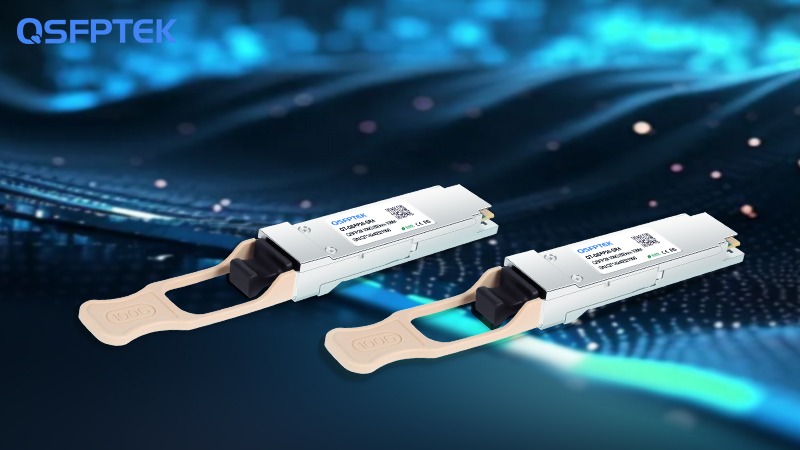
Within data centers, the 100GBASE-SR4 QSFP28 is a mainstream and economical choice for achieving 100G high-speed interconnects within 100 meters. When selecting, please focus on the following key considerations:
Define the Core Positioning: Short Distance, High Density, Low Cost
The SR4 such as the Mellanox MMA1B00-C100D is designed for short distances, using 850nm wavelength and multimode fiber, transmitting in parallel via an MPO interface. Its biggest advantage is that it supports 100 meters on OM4 fiber and 70 meters on OM3 fiber, making it ideal for connections between racks or even across racks within a data center. Furthermore, its total cost of ownership (module + fiber) is the lowest among 100G solutions.

Focus on Two Key Technical Indicators
Transmission Distance and Fiber Optic Cable: This is the primary check item. Ensure your link length (including redundancy) is within 100 meters and identify whether the deployed fiber is OM3 or OM4 to match the module’s effective transmission distance.
Equipment Compatibility: This is crucial for proper operation. Mainstream network equipment vendors often use proprietary code to “lock” modules. Ensure that the SR4 modules you purchase have been cracked or certified to be fully compatible with your switch brand (such as Cisco, Huawei, etc.) to avoid incompatibility issues.
Focus on Two Key Performance and Cost Factors
Power Consumption and Heat Dissipation: In high-density deployments, 100G QSFP28 module power consumption directly impacts electricity costs and heat dissipation pressure. High-quality SR4 modules typically consume ≤3.5 watts. Choosing low-power models helps improve energy efficiency and long-term operational stability.
Total Cost of Ownership: Don’t just look at the unit price of the module. Consider the cost of the accompanying MPO fiber optic patch cords, the electricity savings from low power consumption, and the reliability and warranty service of the supplier. Bulk purchases usually yield better prices.
Reserve Flexibility for the Future
Consider the module’s ability to be split for various applications: Some SR4 modules support splitting one 100G port into four independent 25G ports for connecting high-performance servers, greatly improving deployment flexibility. Meanwhile, the high-quality OM4/OM5 multimode fiber systems currently deployed for SR4 can be reused when smoothly upgraded to higher speeds (such as 400G) in the future, representing a forward-looking investment.
In summary, when purchasing 100GBASE-SR4, please follow these steps: First, ensure the transmission distance is within 100 meters and multimode fiber is used; second, ensure the module is compatible with your network equipment brand; then, prioritize low-power (≤3.5W), splittable products from reliable suppliers to optimize long-term costs and flexibility.




Leave a Reply