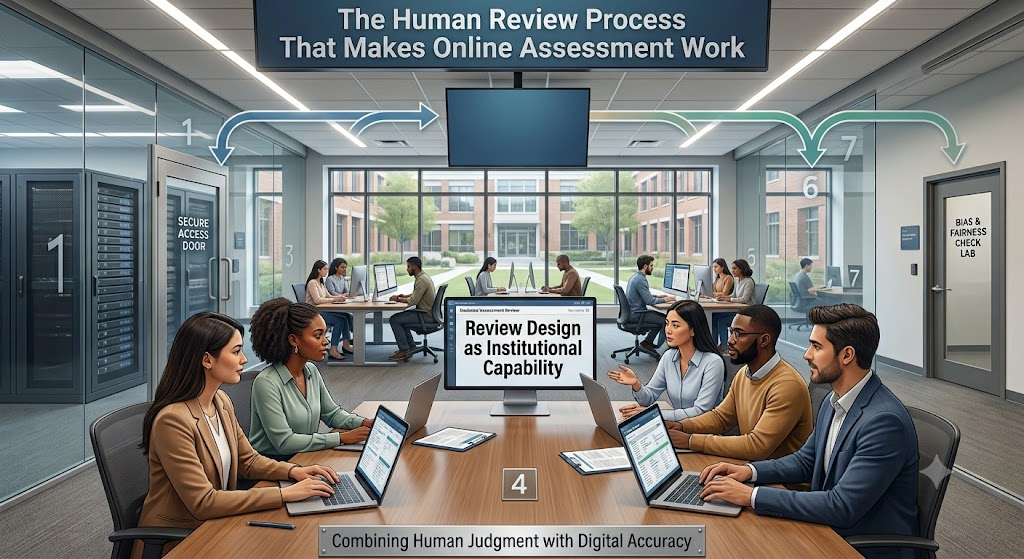
Online assessment has matured considerably as a permanent feature of higher education and professional testing. Institutions have built real capability: large cohorts can now sit exams across locations and time zones, identity verification has become more sophisticated, and monitoring systems capture far more contextual information than a physical exam hall ever could. The credibility question facing assessment leaders today is not whether online systems work. It is how to build the review processes that make everything those systems capture genuinely useful.
That is a governance and workflow question as much as a technology one, and it is where the most experienced assessment teams are now focusing their attention.
A Flag Is the Beginning of a Process, Not the End of One
Automated monitoring solves a real scale problem. Without it, the volume and geographic spread of modern online assessment would be unmanageable. What automation does exceptionally well is surface events that warrant closer attention: unusual gaze patterns, identity discrepancies, browser activity, audio anomalies and room irregularities that a human observer could not track across hundreds of simultaneous sittings.
A study published in Open Praxis in 2025, titled Systematic Narrative Review of Online Proctoring Systems and a Case for Open Standards, confirmed that AI and biometric processes are now widely used to authenticate students and identify possible rule breaches. The review’s more instructive point was that flags function best as prompts for human decision making, because the meaning of any behavioural signal depends on context that automated systems alone cannot fully interpret.
That is not a limitation unique to online assessment. It is how evidence works in any rigorous process. A flag begins a review. A review produces a finding. The institution acts on the finding. Each stage requires different capability, and building all three well is what separates a defensible integrity process from one that merely looks active.
Context Is Where Institutions Add the Most Value
Students sit online assessments in a wide range of environments: bedrooms, shared housing, regional offices, library spaces and locations with variable connectivity. Many have disability accommodations, anxiety responses or technical circumstances that produce unusual signals without indicating any breach of rules. A gaze movement may reflect concentration, screen layout or stress. Background sound may be a shared household rather than collaboration. A camera angle that was never properly checked before the exam began may flag a face leaving frame repeatedly throughout a sitting.
Experienced assessment teams already understand this. The opportunity is to build that understanding into the review workflow systematically, so that proportionate judgement is applied consistently rather than depending on the experience of individual reviewers. A well designed review environment gives reviewers clear criteria, appropriate training, structured escalation pathways and enough contextual information to distinguish a technical anomaly from meaningful evidence of misconduct.
A University of Reading study published in PLOS ONE found that AI-generated exam answers went undetected in 94 per cent of cases in a blind test of a real university assessment system. That finding reinforces the same point from a different angle: no single detection layer, human or automated, is sufficient on its own. The institutions that handle integrity most credibly are those that layer their evidence sources and apply consistent human judgement across all of them.
Procurement Conversations That Focus on the Full Workflow
Assessment leaders selecting advanced proctoring software are making a decision about more than monitoring capability. They are deciding how evidence will be captured, escalated, interpreted and recorded across the full review cycle. The most productive procurement conversations therefore look beyond detection rates and ask how the platform supports the human review process that follows.
Useful questions include how flagged events are presented to reviewers, whether the interface supports consistent application of institutional criteria, how student context and explanations can be incorporated into the review record, and how final decisions are documented in a way that satisfies both institutional governance and external scrutiny. Platforms that are designed with the reviewer’s workflow in mind, not just the detection algorithm, give institutions a stronger foundation for the decisions that matter most.
This is where investment in good technology pays dividends well beyond the exam sitting itself. A clear, well structured review trail is an asset when responding to student appeals, engaging with regulators or demonstrating to professional bodies that integrity processes are both rigorous and fair.
Regulatory Direction Confirms the Integrated Approach
Regulatory frameworks are now reflecting what experienced practitioners have long understood. The European Commission’s Navigating the AI Act identifies education and vocational training as a sensitive area for high-risk AI use, with obligations around transparency, documentation, traceability, accuracy and human oversight. For assessment technology specifically, this means institutions will increasingly need to demonstrate not only what a system detected, but how a person or review body assessed that evidence before any consequence was applied.
Australian providers face equivalent expectations, even where regulatory language differs. Students, professional bodies and accreditors are unlikely to accept automated detection as a complete answer. They will expect a documented review trail, clear thresholds and a process that explicitly separates a flag from a finding.
Institutions that have already built that kind of structured review process are well placed. The regulatory direction is not asking them to do something new. It is asking them to make visible and documentable what good assessment governance has always required.
Review Design as Institutional Capability
The institutions managing online assessment most effectively are those that treat human review not as a fallback when automation reaches its limits, but as a designed capability in its own right. That means deciding in advance what triggers a review, who conducts it, when a matter escalates, how student explanations are incorporated, and how outcomes are recorded and communicated.
With that structure in place, automated monitoring becomes considerably more powerful. Every flag it surfaces enters a process that is equipped to handle it proportionately, consistently and with full documentary support. The technology and the human process reinforce each other, and the institution can stand confidently behind every decision that results.
Online assessment at scale depends on automation. What makes that automation genuinely valuable is the review infrastructure built around it.




Leave a Reply